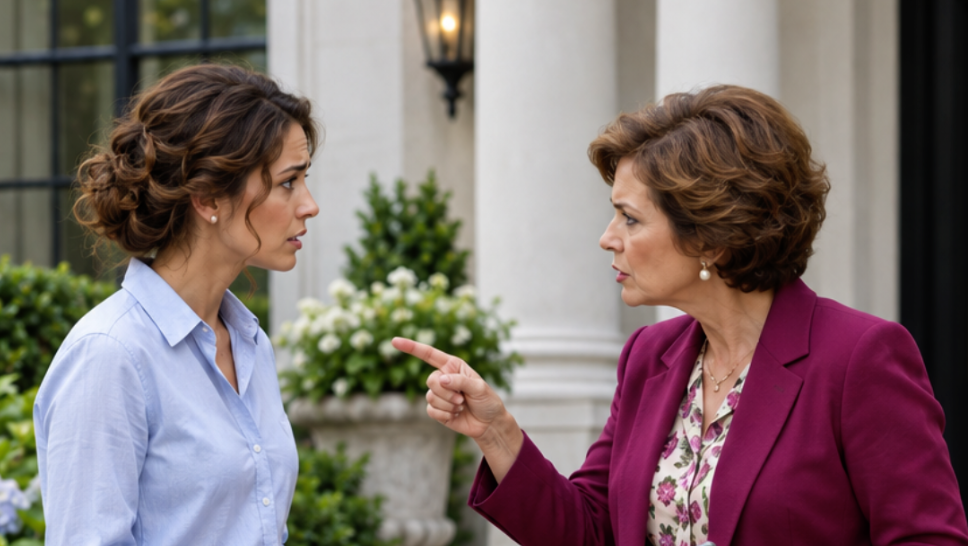
My mother-in-law was yelling so loudly into the phone that I could hear the membrane rattling even with the phone at arm’s length. Artyom stood barefoot in the middle of the living room, wearing a wrinkled T-shirt, staring not at me—but at the wall. I was sitting on the floor by the disassembled vacuum cleaner, gripping a Phillips screwdriver.
“Mom, calm down. What police? Do you even hear yourself right now?”
I couldn’t make out her answer—just a barrage of sounds, barking. Then he pulled the phone away.
“She says you stole a brooch. The garnet one. Grandma’s.”
The screwdriver slipped from my hand, clattering against the plastic. I wiped my hands on my jeans and stood up.
“Let me have it.”
“Why?”
“Just give it here.”
The phone was in my hand. My mother-in-law’s breathing was fast and heavy—like after climbing multiple flights of stairs.
“Tatyana Ivanovna, I didn’t take anything.”
“You’re lying. You spent half an hour alone in my bedroom yesterday. I checked. The brooch is gone. No one else was there but you.”
Half an hour. She had asked me herself to look at the closet—the sliding door stuck. I was fiddling with the track, while she was in the kitchen telling Artyom he’d married someone completely unknown. My hands were busy—that she’d admit. She took advantage of it.
“If you call the police, it’ll only make things worse for you. No complaint means no theft. I never touched your brooch.”
“You…”
She hung up.
Artyom rubbed the back of his head. That gesture meant: “Why did you provoke her?” I had learned his body language in two years. A bitten lip meant, “You have no idea how to handle her.” Drumming his fingers on the table meant, “I’m tired of being in the middle.” Hands behind his back meant, “I’m ashamed, but not for her.”
He grabbed his keys from the dresser.
“I’ll go to her place. You just… breathe. Try to stay calm.”
The door slammed shut. My windbreaker—blue, with a bleach stain—swung from the hook. Tatyana Ivanovna had called forty minutes after we returned from vacation: “The faucet’s leaking, the plumber can’t come for a week.” Artyom started to go over himself. She said: “You’re all thumbs.” Then looked at me.
I fixed her faucet. Replaced the gasket in her washing machine. Adjusted her TV—there was static. Every time it was the same: a call, a complaint, “It’s nothing for you, you’re home all day anyway.” That’s what she called my remote job. I’d go, I’d take care of it. She never thanked me—just checked my work.
Now something’s missing. The brooch. The garnet one. From her grandmother.
I reassembled the vacuum cleaner on autopilot—my hands remembered the motions. My mind kept replaying yesterday: the closet, white doors with gold embossing. I took out the track, cleaned the groove, lubed it with silicone. During that time, she came in once—brought a glass of water. Set it on the dresser. The glass fogged up, a droplet slid down the lacquer. She followed my gaze, moved the glass onto a napkin. Then left.
No sign of any brooch. Not even a jewelry box—she kept her jewelry in the top drawer, locked. I knew this: once, in front of me, she’d opened it, searching for a chain—to show me “what her mother used to wear, before this age of costume jewellery began.”
And I knew something else. I’d seen it. But I hadn’t told Artyom.
An hour later, he came back. Threw his keys down, took off his sneakers, headed to the kitchen. I was peeling an orange—the peel broke under my fingernails, juice squirting everywhere.
“She filed a report. With the local officer. They’ll call tomorrow.”
A wedge stuck in my throat. I cleared it.
“So what did you do?”
“Told her you couldn’t have done it.” He picked up an apple from the fruit bowl, turned it over in his hand, then put it back. “She said, ‘Then who? A ghost?’”
“Maybe a ghost.”
“Dasha.”
“What, Dasha? The drawer was locked. How?”
“She says the lock was open after you left. And the brooch is missing.”
I finished my orange, wiped my fingers on a towel, crumpled it up, tossed it toward the bin—and missed. I didn’t bother to pick it up.
“Artyom. You know where her brooch is.”
His back tensed beneath his T-shirt.
“Don’t start.”
“You saw it. Six months ago. She took it off right in front of you and didn’t put it in the jewelry box—she put it in an envelope.”
“That was six months ago.”
“So what? You think she forgot? Your mom remembers how many eggs are in the fridge and when the meter check is due. She doesn’t lose things. Especially her grandmother’s brooches.”
He turned around. There were dark shadows under his eyes.
“So what do you want me to do? Go and say, ‘Mom, you hid it yourself just to frame Dasha’? She’ll say I’m a traitor. That I chose another woman over my own mother.”
“I’m not another woman. I’m your wife.”
“To her, you’re a stranger.”
It was just routine. I didn’t even feel hurt. Like an exchange rate. My mother-in-law considered me an outsider—fine. I’d lived with that for two years. I would’ve kept living with it. If it weren’t for the call to the police.
The district officer called the next day. Captain Gorelov. Asked me to come in. I went. Artyom wanted to come with me—I refused. Enough.
A guy around forty, the face of someone who handles neighborhood quarrels about parking and dill patches every day. Questions, paperwork. I was there, I fixed it, I didn’t see it, I didn’t take it. I asked about fingerprints on the jewelry box—he grunted, “That’s for Investigations, if a case is opened. For now—it’s just a chat.”
I stepped outside and sat on a bench in the park. Strollers, kids, pigeons fighting over bread. I watched and thought: this is absurd. Suspected of stealing something I didn’t take. My mother-in-law lies. My husband knows—but chooses neutrality. And here I am, sitting here because I couldn’t say ‘no’ for two years. I’d go when she called, fix things. She’d criticize my haircut—I’d smile. Forgot her birthday—I’d tell Artyom, ‘It’s fine, she’s busy.’
One of her ‘tasks’—methodically destroy my marriage. Not because I’m bad. Because no matter who stood in my place, she’d be bad. Just because.
That evening I called my aunt in Murmansk. Not for advice—just to hear a voice that wouldn’t judge me. Forty minutes. Weather, fish prices, new neighbors. At the end she asked, ‘Are you alright, Dashka? You sound different.’ I said, ‘I’m fine, Aunt Vera. Just tired.’
I lied, even about little things.
At night, lying in the darkness, I stumbled upon the answer. It had been there all along. Like the envelope in the dresser—I’d seen it six months ago. I’d gone in to call Tatyana Ivanovna to dinner. The door was ajar, her back to me, moving things from the jewelry box to a yellow envelope. The brooch. Deep red stones, antique gold. It flashed in her fingers, then disappeared into the paper. She turned and said: “Just sorting things out. Decided to reorganize.”
I thought nothing of it then. Now I knew for sure.
In the morning, I called Gorelov again. Asked for another meeting. This time, I didn’t go alone—I brought the neighbors from her floor. Yuri Petrovich from apartment 25, the one who always complains about noise, and his wife. The officer raised his eyebrows. I insisted.
“If Tatyana Ivanovna claims the brooch was in the jewelry box, that’s one thing. If she put it in an envelope in the dresser, that’s different. The envelope isn’t out in the open. I couldn’t have found it. And if she says there was no envelope, that’s a lie. We have witnesses.”
I lied, of course. I saw the envelope. “Not in plain sight” was a lie too. It was under her linens. But I stand by this: the envelope did exist. Honestly, I don’t know if the brooch is still inside now. Maybe she hid it elsewhere. Maybe she sold it.
But when Tatyana Ivanovna heard about the search with witnesses, she called Artyom. Not me—him. She still believed she could control things through her son. He arrived and said:
“She’s withdrawing her statement.”
I was sorting buckwheat, the grains slipping through my fingers, light and cool.
“Why?”
“The brooch turned up. In that same envelope. She hid it and forgot all about it.”
“She hid it and forgot,” I repeated, pouring the buckwheat into a pot. “And what about the police? Her reputation? Those two hellish days?”
He stood by the doorframe, arms crossed, hands clutching his elbows.
“She asks for forgiveness. She wants you to come over. To talk.”
“Let her come here herself.”
“Dasha…”
I turned on the water. Washed the grain three times, drained it, set it on the stove. Then I turned to him.
“Artyom, your mother tried to have me arrested for theft. Not figuratively—literally. She filed a report to the police, knowing the brooch was in her dresser. She lied to you, to the officer, and to herself. And you want me to just play along?”
“She’s an old woman.”
“She’s an old manipulator. That’s not the same thing.”
He stayed silent. I could see it tearing him apart: the reality where his mother was a saint, and the reality where she was a liar. Choosing the second meant admitting he’d been complicit. Out of weakness, not malice.
He couldn’t do it.
“I’ll talk to her. To make sure this never happens again…”
“No. I’ll do it myself.”
The next day, I went to see her. No Artyom. No neighbors. No bag—I left it in the car so nobody could accuse me of stealing anything new. Just my phone and keys in my jeans pocket.
She answered after the third ring. Puffy eyelids, a wrinkled old robe, grey roots—she dyed them every two weeks, and her time was up. She hadn’t slept.
“Come in.”
The hallway smelled of dust and medicine. On the cabinet, a bottle of Corvalol, and a spoon with a white residue. We went to the kitchen. The table was bare—no tablecloth, no vase. Just a plastic tabletop and two chairs facing each other.
We sat down.
“I want to apologize,” she said, looking at the table. “I forgot. I’m old. My memory.”
“You didn’t forget. You remembered from the very start. When you shouted at Artyom about having a thief in the house.”
She pressed her lips together. Red blotches appeared on her cheeks.
“You don’t understand. You took my son from me.”
“He chose me.”
“He made the wrong choice.”
The air finally cleared of unspoken words. Outside, the wind was noisy, blowing poplar fluff along the windowsill.
“I know why you did this,” I said. “You wanted Artyom to choose. To defend you, condemn me. You thought: he’ll see I’m a thief—be horrified, and leave me. And if he doesn’t, he’ll become an accomplice, so you’d have leverage. ‘Your wife’s a thief, but I forgave her.’ Sounds noble. But it didn’t work.”
“That’s because you turned him against me.”
“No. He saw the envelope. He knew the brooch was there.”
The color drained from her face. She didn’t know. She had no idea Artyom had gone into the bedroom that day too. He’d stood in the doorway while she moved the jewelry, then left without a word. He told me yesterday. I asked him directly, “You knew?”—”I knew.” Short. Dry. Like a gunshot.
“You’re lying.”
“Shall we call him?”
She covered her face with her hands, her shoulders shaking. I didn’t move. This wasn’t theater. She had risked everything—and lost. She’d counted on her son’s loyalty, but he saw her lies and kept silent. He waited to see how it would end.
I lowered my hands. My face was wet, but my gaze stayed sharp and dry.
“So what now?”
“Promise me. Not Artyom—me. No more calls asking for help to fix things. No more unexpected visits. No criticism. I’m not asking for love. Just neutrality. Like countries keeping the peace. Can you do that?”
She was silent. Gave a dry nod.
I stood up, walked to the hallway, and took hold of the doorknob.
“And if I can’t hold back?”
“Then I’ll leave Artyom. You’ll get him back. But he’ll know exactly why I walked away. I doubt he’ll thank you.”
The door clicked shut. The elevator smelled like bleach and someone else’s dinner. I sat in my car, not moving for a minute. A ladybug—bright red with black dots—crawled stubbornly upward on the windshield. I rolled the window down and flicked it gently into the air.
That evening, Artyom asked, “So, how did it go?” “We talked. She’ll respect the distance.” He nodded. He didn’t ask how I did it. Maybe he was afraid to. Maybe he understood: it was me who made it happen.
I saw the brooch six months later. A family gathering, we arrived together, hand in hand. My mother-in-law in her chair, sitting straight. Dark red stones gleamed on her chest. She caught my gaze and covered the brooch with her hand. I looked away first. It wasn’t surrender. The war was just over. A fragile, uncertain peace. I paid for it with two days and one conversation that taught me how to say ‘no’.
That was enough.