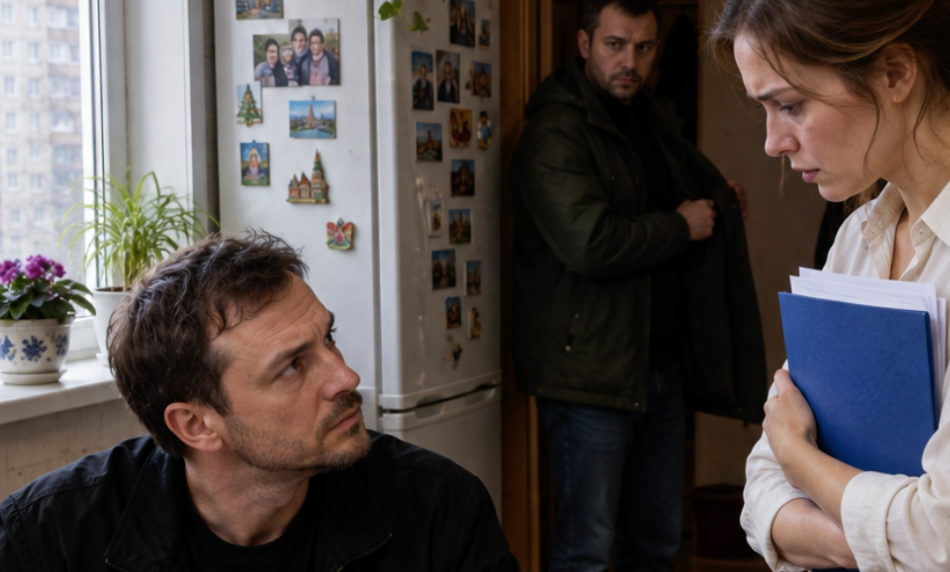
Around 1 PM, I was stopped at the border and not allowed to leave, even though the next morning in Bursa they were waiting for my signature on a contract. My husband was standing in the departure hall, certain he knew how it would all turn out. All I knew was that someone would have to pay, and the only question was to whom and how.
The border officer scanned my passport twice and looked at his screen as if someone else’s name had come up instead of mine. Then he handed back my passport and pulled a sheet of paper from the printer.
“Larisa Andreevna Ershova, there is a temporary travel restriction issued against you,” he said. “The reason is an enforcement proceeding. The case number, the name of the bailiff’s office, and a phone number are listed here. I can’t let you through.”
“This is a mistake,” I replied, my cheeks burning. “I don’t owe anyone anything. My flight is at 15:25, and tomorrow at 10 AM in Bursa they’re signing the contract.”
“Mistakes are fixed at the bailiff office, not at my border post,” he said, already looking past me to the next person in line. “Please step aside, you’re holding up the queue.”
I stepped aside. My suitcase wheel got stuck in the tile joint and scraped loudly, so I yanked it, and the suitcase toppled over. The sheet of paper fluttered in my hand: case number, office name, Bykova N. Yu. None of it meant anything to me.
Gena should have left long ago. At two, he had a client with a Hyundai and a busted suspension, and he himself had said he wouldn’t hang around the parking lot. He drove me, rolled my suitcase to the counter, kissed the top of my head, and promised to wait for me on Sunday with gifts.
Now he was standing by a column across from the security entrance, in his auto service jacket, spinning his car key on his finger. He didn’t ask why I was back. He was smiling.
“Gena, they’re not letting me leave,” I said. “Some kind of legal case, some bailiffs. Can you explain what’s going on?”
“You’re not going anywhere, your debt is registered,” he smirked, swinging his key. “Don’t worry, Larik, it’s all official, on paper. IOU, order, court case. Slava did everything by the book.”
“What IOU? I never borrowed anything from Slava.”
“Three hundred thousand, and your signature is right there,” he replied. “By the time you figure out what you signed and where, your plane will be landing in Istanbul.”
I stood with the folder under my arm. He was waiting for me to yell. Instead, I counted his key’s spins: five, six, seven. On the eighth, he sighed like a man tired of explaining the obvious.
“Alright, let’s skip the drama. Slava gave me three hundred thousand for the lift—you saw the photos. I don’t have the money yet to pay him back, and he calls me three times a day. But you still have money set aside for your dental work. Two weeks ago, I asked you nicely, and you just talked about the garage. So I did what I had to do.”
Back in March, while I spent a week in Bursa negotiating a trial batch, he sent me photos: a blue car lift on a new frame, still wrapped in factory plastic. “Slava helped out, gave me money for the lift, bought it today, everything’s under control,” he wrote. I replied, “Good job.” It felt good to see him achieving something.
Two weeks ago, he sat down on the edge of the bed and said that Slava needed to close out some issue, and that, as far as he knew, I might have some money set aside for dental work. I told him the problem was his, so he could go sell the garage if he needed money. I thought that would be the end of it.
“At the beginning of the week, forty-three thousand was debited from my card,” I said. “The bank explained it was ‘by court order,’ but you said it was just a car tax.”
“It was the tax, just processed through the bailiffs,” Gena replied, completely unfazed. “You never want to bother reading all this paperwork, Lara. I’ve been dealing with your papers for years. Not once have you ever said thank you.”
I opened the Government Services app—I wanted to see for myself what information they had about me. The app offered to send a code to a number ending in 47. That was Gena’s number. He’d once set up the account on his phone for me, since I only had a work number, and I just never got around to switching it over.
His phone buzzed in his pocket. He pulled it out, checked it, and then turned the screen toward me.
“Want me to read you the code?” he asked, winking.
Then he put the phone away and got down to business, like he was talking to a client.
“Alright, listen. Transfer two hundred sixty thousand to Slava—he’s already received forty-three. He’ll withdraw the document from the bailiffs today, and you can go off to Turkey as planned. Don’t deal with the bailiffs yourself; they lift restrictions the next day, but you fly out at ten tomorrow morning. Do you really want to risk that?”
I listened and did the math. Viktor Lvovich had been clear: if I signed the contract for the Bursa delivery, I’d get an assignment and a three-year contract with half the income calculated as a percentage of turnover. If I didn’t sign, the assignment would go to Elvira, who still couldn’t tell FOB from CIF after three months. My flight was in two and a half hours.
In the side pocket of my folder was my March expense report, with tickets and hotel receipts from Bursa—I’d been meaning to turn it in to accounting for three months now. The urge to smack Gena’s smirk with that folder was so strong, I was surprised by how clearly I felt it.
“Two hundred sixty thousand,” I repeated.
“Two hundred sixty, Larik. Just think of it as helping your husband, not Slava.”
I nodded. Gena broke into a grin; his eyes always warmed up when I gave in, and in that moment, he looked like the guy I married when I was twenty-three. When I grabbed my phone, he probably thought I was opening my banking app. But instead, I found a piece of paper and dialed the number it listed.
* * *
The phone played the same twelve-second elevator music loop while I waited on hold. On the seventh round, I was transferred; on the eleventh, transferred again. Gena stood two steps away, not budging; judging from his face, he was actually curious about how this would play out.
“This is bailiff Bykova,” a dry female voice finally announced. I could hear keyboard tapping in the background. “How can I help you?”
“Yershova Larisa Andreevna. I wasn’t allowed to leave the country today—I have your case number on a slip of paper. I need to know what I can do to get the restriction lifted today.”
— Ershova… — The keys clattered faster. — That’s right. Order from the justice of the peace, collector Pakhomov Vyacheslav Nikolaevich. The order is for 303,100 rubles, 43,100 has already been withdrawn, the remaining balance is 260,000. The restriction was imposed yesterday. Pay the balance, and I will issue an order to lift the restriction.
— I need the basis, — I said. — The date and the document that the order was issued on.
— An IOU from March fourteenth, attached to the application for the order, — Bykova replied. — Are you listening to me, citizen Ershova?
I was listening. I stood in the middle of the departure hall while a stranger named a day I remembered down to the hour. I opened my chat with Gena and scrolled up to March.
March fourteenth, 19:42. A blue car lift still in plastic wrap and a caption: “Slava helped out, gave the money for the lift, bought it today, everything’s under control.” That evening, I was having dinner with the factory director at the Burse, discussing the price of gabardine. The IOU that supposedly proved I borrowed money from Slava was dated the exact day he handed it to my husband.
I pulled the advance report from my side pocket. Boarding passes, hotel receipt, dinner bill—all stamped with the fourteenth date. Gena himself had driven me to the airport with that folder.
— Ershova, are you still on the line? — Bykova repeated.
— I’m here, — I replied. — Can I officially record my written position in the case? I will pay, but only because I have no choice, so I can leave the country. I do not acknowledge the debt, I did not sign the IOU.
— If you want to challenge the basis, that’s not up to me, I’m not the court, — Bykova said. — I just execute the document. Send a statement to the department’s email, I’ll register it as an incoming document. Registration doesn’t mean I agree with you. Send the bank-stamped payment order to the same email, it’s faster than waiting for the payment to show up in the system. My work day ends at six.
She dictated the address. As soon as he heard the word “statement,” Gena stopped twirling his keys.
— Are you calling the bailiffs? — he asked. — I told you: call Slava. If you go through the department, you’ll be stuck until tomorrow.
— Slava could withdraw the document, or he might not, — I replied. — But only a bailiff issues the release order. I want to get it today.
— But you nodded, Larisa, — he said, looking at me as if I’d shortchanged him on change. — I saw you.
— I nodded to the fact that the debt is officially recorded, — I answered. — I didn’t nod about Slava.
I sat down on my suitcase by a column with an outlet, plugged in my phone (it was at nineteen percent) and wrote out my statement in my notes. Three sentences: I’m making the payment under duress, only to lift the travel restriction; I do not recognize the debt, I did not sign the IOU, and on the date listed in it I was abroad; I ask to retain my right to demand a refund. I sent it to the address Bykova had dictated.
The account was called “Teeth.” That’s what I named it three years ago. I’d been protecting my lower right tooth all this time and chewing on the left, saving ten or fifteen thousand at a time for implants, denying myself boots and vacations. I transferred 260,000 rubles to the card. The app asked if I was sure I wanted to do this.
In the section for debts with the bailiff service, my name popped up along with an amount—as if I was a serious debtor. I hit ‘Pay’. It was just after two.
The airline desk attendant kept tapping away at her keyboard for ages. My 3:25 pm flight was departing without me. The next one to Istanbul was at 9:40 pm. I needed to clear security before 9, and the fee to change my booking was nearly thirty thousand. I tapped my card—no questions asked.
I messaged my boss: “Viktor Lvovich, I’m catching the night flight, will be at the factory by ten.” He replied a minute later: “If you make it, you’ll sign. If not, Elvira will go instead—I bought her ticket in advance.” That “in advance” really bothered me.
Gena stepped a few paces away and spoke quietly into his phone, but I could still hear him.
— Slav, she’s resisting… No, she wants to go through the department, you’ll still get your money. She’s got some paperwork for them, no idea what… How should I know what document it is.
Then we waited. Gena was two seats away, scrolling through his feed. Bykova replied to my email with one line: “Application registered, instruction received.” The screen kept changing, queues were forming for other flights. Meanwhile, it seemed like my payment was still circulating through banking channels.
At 5:40 pm, Bykova didn’t pick up right away.
— Ershova, the application is registered, I’ve got the instruction, — she said. — But the payment isn’t showing up in the system yet, and I haven’t received a reconciliation from the bank. Without that, there’s nothing to sign. My shift ends at 6 sharp, and anything unsigned goes to tomorrow. That’s all I can promise you.
I held it together for three hours, but now my fingers started shaking, and I entered my unlock code wrong twice. Gena scooted closer. His voice softened, almost empathetic.
— See? I told you, Larik. Slava is still available. Transfer him the money now, he’ll withdraw the document, and we can still make the evening flight.
— If I send the money to Slava, it’ll look like I willingly paid off a debt I never owed, — I replied. — Money like that never comes back, Gena. And the payment through the department stays as a payment linked to my application.
— Who exactly are you trying to prove something to? Your signature is there, the instruction is there.
— Maybe so, — I said. — Go to your ‘Hyundai,’ you’ve already spent half the day here.
— My Hyundai will survive without me, — he said. — Let’s see how you explain to the boss tomorrow that you’re still sitting in Sheremetyevo.
I refused to transfer the money. Instead, I stared at my phone as the time ticked by: 5:46, 5:50.
At 5:55 pm, Bykova called me herself.
— The reconciliation has come through, payment confirmed, — she said. — I’m signing the order to lift the restriction; it will be sent electronically to the border service. From now on, it’s out of my hands. It might not show up in their system right away.
— Thank you, — I replied.
— It’s my job, Ershova, — she said and hung up.
At twenty past seven, I headed for security. The new border guard, much younger, looked at the screen, then at me.
“The restriction is still showing in the system, but it’s updating,” he told me. “Come back a bit later, you still have time before boarding.”
Gena was waiting for me in the same spot by the column. He understood everything just by looking at my face.
“You’ll fly out in the morning, Larik,” he said gently. “I’m heading off, the Hyundai is waiting. If you need me to pick you up, just call.”
He walked away, twirling his keys around his finger. That kindness from him felt worse than his usual smirk, but once he was gone, I could breathe easier. I sat down on my suitcase next to an outlet and watched the board as flights changed color one by one.
At five minutes to nine, I approached the checkpoint again. The woman behind the counter didn’t look up as she swiped my passport through the scanner.
“The restriction was lifted today at 18:04,” she said. “You can go through now, your boarding is in forty minutes.”
While waiting at the gate, I got a message from an unknown number: “Larisa Andreevna, this is Vyacheslav Pakhomov. I was told at the office that you paid and filed a statement. We need to talk before this goes any further. Gena said you know what’s up.”
I read the message twice and put my phone away. I didn’t respond—the boarding process had already started.
* * *
In Bursa, I signed the delivery contract at 10:20—the factory director was late, and I managed to get three hours of sleep in the car on the way from Istanbul. Viktor Lvovich sent me a message with just three words and an exclamation mark.
Two days after returning, I filed objections to the order and a motion to restore the deadline at the magistrates’ court. I attached my tickets, a report, the hotel receipt, and screenshots from a March 14th conversation, explaining that my husband had collected court letters and I didn’t know about them. At the police station, I filed a statement about the forged receipt. On the eighth day, I received the court’s decision: the deadline was restored, and the order canceled.
Only after that did I reply to Slava, telling him to come by Wednesday evening, around seven. I let Gena know we’d have a guest that Wednesday.
Slava showed up exactly at seven, carrying a folder, still wearing his jacket. He spent a long time wiping his feet on the mat, and when he entered the kitchen and saw Gena at the table, he paused at the doorway. Our table seats four, covered with a checkered tablecloth I bought with my first paycheck. Gena sat in his usual spot by the radiator, drumming his fingers on the sugar bowl.
I set four documents on the table: the March 14th message thread with a photo of the lift, the Bursa hotel receipt, the court decision, and my police slip with the statement number.
“Read them, Vyacheslav Nikolaevich,” I said. “Then we’ll talk.”
He read them, mouthing the words, and his forehead visibly dampened with sweat. Gena broke first.
“Lar, why make a scene in front of people,” he said, trying to laugh it off. “We’re family, we can sort this out among ourselves.”
“These aren’t just people, Gena, this is Vyacheslav Nikolaevich—you owe him three hundred thousand,” I replied. “And he knows it even better than I do.”
Slava looked up.
“Gena told me you were aware of everything and were just dragging it out,” he began. “That you had all decided at home. I mean, I didn’t think… Anyway, on March fourteenth I transferred the money to Gennady Sergeevich, here’s the receipt. And he brought me a written note, already prepared. Said you had signed it, and there was no need for a notary – just extra expenses.”
“Slava, what are you talking about?” Gena said, stopping his tapping. “Remember how we…”
“I remember,” Slava interrupted. “I remember I have a state contract with the motor pool and four staff on payroll. I don’t need a forgery case, Gena. Not for any three hundred thousand.”
He took out his phone and, right in front of me, transferred three hundred and three thousand one hundred rubles to me. I waited for the bank notification, and then Slava tore a sheet from his notepad and wrote a statement: on March fourteenth, he gave the money to Ershov G. S., the receipt was brought by Ershov G. S., he hadn’t met with Ershova L. A. He signed it and wrote the date.
“The police report was filed against whoever wrote the receipt,” I said, taking the paper. “What you say there is up to you.”
“Larisa Andreevna, I…” he started.
“You can go, Vyacheslav Nikolaevich. The debt is back with the one who took it. Sort things out with Gena yourself, honestly.”
Slava left, gently closing the door behind him as if someone was sleeping in the apartment. Gena sat staring at the sugar bowl.
“Twenty-four years, Lar,” he finally said. “All of this over three hundred thousand?”
“You stood by the column and smiled, Gena,” I replied. “Three hundred thousand has nothing to do with it.”
He went into the other room, and a minute later the TV came on. I put the sheets in the folder in order, just as I always did. The money for “Teeth” was returned in full, and I immediately made an appointment with the dentist.
Then I opened the Gosuslugi app. The application offered to send a code to a number ending with 47. I clicked on “Change Number” and entered mine.
Nothing made a sound in Gena’s room. The code came to me.