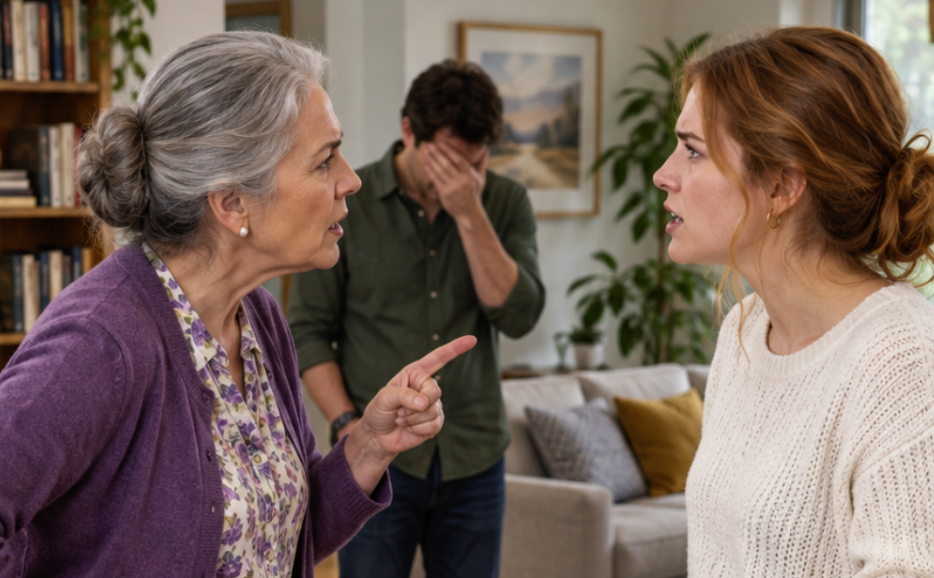
My husband’s grey jacket was draped over the back of a chair. It smelled like the street, the subway, and someone else’s cigarette smoke. I stood in the kitchen doorway, staring at that jacket, feeling a tight knot forming inside me. Meanwhile, my mother-in-law was sitting at the table, scrolling through my phone—without asking. The screen glowed as her fingers with their dark red manicure glided confidently and proprietarily across the glass.
“Did you change the password?” she asked, not looking up.
“I did.”
“Keeping secrets from your husband’s mother?” she snorted. “Fine, I didn’t really want to know anyway.”
She tossed the phone onto the table with a dull thud, screen down. I walked over, picked it up, and slid it into the pocket of my lounge pants.
She had been living with us for three months. She’d come from Nizhny to help with the renovations, but those were finished in the first week—we put up new wallpaper in the hallway and repainted the radiator. After that, a different story began. She just stayed. Didn’t even buy a return ticket. Andrey stayed silent. When I brought it up, he only said, “Well, she’s my mom, I can’t kick her out.”
Can’t kick her out.
I turned toward the stove. Soup was cooling in the pot. My mother-in-law kept sitting there—back straight, hair in a tight bun, lipstick reapplied three times a day. She was sixty-three, but she carried herself like she was thirty-five and the whole world was at her feet.
“Alina,” she said.
I turned around.
“I’ve been thinking. We need to settle the issue with your sister.”
My hand froze over the pot.
“What issue with my sister?”
“She comes over every weekend. It’s a bit much.”
Lida came by every Saturday. We drank cocoa, watched movies, chatted. Sometimes she’d stay the night in the living room. The sofa was old and saggy, but Lida liked it—she said she always had good dreams there.
“My sister comes to visit,” I said. “To the apartment where I live.”
“To the apartment where my son lives,” my mother-in-law corrected me. Her voice was calm, almost affectionate. That was the most infuriating part. “And where I’m living for now. And your sister… well, you know. Andrey doesn’t really like her.”
“Andrey never said that.”
“He won’t say it to you. He’s considerate. But he tells me everything. We’re very close.”
She smiled—lips pressed together, corners turned up, like she was checking off a box in a report.
I turned off the stove and sat across from her. My mind was spinning.
“Let’s be direct,” I said. “What do you want?”
She leaned forward. I could smell her perfume—heavy and sweet, it had seeped into the curtains, the furniture, even my clothes hanging next to her coat in the hallway.
“Either you register my sister here”—I put emphasis on ‘my’—“or you move out.” Was my audacious mother-in-law really trying to boss me around?
I said that last sentence slowly, tasting the words. It sounded foreign, like I was quoting someone else.
My mother-in-law leaned back in her chair.
“I’m not giving orders,” she said. “I’m making a suggestion. As family. Don’t you want peace in the house?”
“Peace at my sister’s expense?”
“Why such sacrifices? Just ask her to come by less often. Or meet up somewhere in the city. Why does she have to keep coming here?”
I stayed silent. The words just wouldn’t come out. Lida comes here because she has nowhere else to go. Her husband kicked her out two years ago, and now she rents a tiny room in Mytishchi—with a window facing a brick wall. Here, with us, she can finally thaw out. There’s real light, there’s me, and she can just relax on the couch and watch silly shows, not worrying that tomorrow she’ll have to face another day at that office she absolutely hates.
My mother-in-law didn’t know any of this. Or maybe she did—and just didn’t care.
“I’ll think about it,” I said.
“You think about it,” she said as she stood up and adjusted her bun. “But not for too long. Andrey is getting anxious too. You can see it—he’s gotten irritable.”
Andrey has gotten irritable. That’s true. For the past few weeks, he’d come home from work, eat in silence, and then lock himself away in the bedroom with his laptop. Whenever I asked him anything, he’d give short answers. I kept blaming it on his exhaustion. On the stress at work. On the magnetic storms.
Now I just sat there, going over the facts in my head.
Andrey hadn’t said a word to me about Lida. But he’d apparently said something to his mother.
Or she was lying.
I grabbed my phone and opened up the chat with my husband. I typed: “Did you ask your mom to talk to me about Lida?” Deleted it. Typed again: “Your mom just gave me an ultimatum. Did you know about this?” Deleted it again.
I got up and went to the bedroom. His bathrobe was lying on the bed, and on the nightstand was an open book he’d been trying to read for three months—still stuck on chapter five. I picked up the book and idly flipped through the pages. A receipt slipped out.
Pharmacy. Phenazepam. The date was yesterday.
I stared at the little white rectangle, and my temples started to pound.
Andrey never took tranquilizers. He was always against pills—even for a headache, he’d hold out as long as possible. But now—phenazepam. Prescription meds.
I put the receipt back where it was. Walked out to the hallway. My mother-in-law was making a racket in the kitchen—she seemed to be rewashing dishes I’d already done.
That evening, Andrey came home. I was waiting for him in the living room. I didn’t turn on the light—just sat in the dimness, staring at the rectangle of our window, watching the glow from the neighbors’ windows outside.
“Why are you sitting in the dark?” he asked as he walked in.
“Sit down.”
He hesitated, slipped off his shoes, stepped in, and sat down—not on the sofa next to me, but in the armchair across from me.
“Your mom told me today that Lida isn’t allowed to come over anymore.”
Silence. A long one. He reached for the coffee table, picked up the remote, turned it in his hands.
“Andrey.”
“I heard you.”
“Did you ask her to say that?”
He looked up. In the semi-dark, I couldn’t see his expression—just the glint of his eyes.
“No,” he said. “I didn’t ask her. But…”
“But what?”
“But she’s right.”
I waited. There was no clock in the room. Just my breathing, his breathing, and the gulf of two meters between us that suddenly felt impossible to cross.
“Lida’s an adult,” Andrey finally said. His voice was weary, like he’d been having this conversation with himself for a long time. “She has a job. She can rent a bigger place. She could get a roommate. She could…”
“You don’t want her to come over anymore?”
“I want our home to actually feel like our home. No guests every weekend.”
“She’s not a guest. She’s my sister.”
“And I’m your husband. Whose wishes matter more?”
The question hung in the air. I knew the right answer—what everyone expected from me. My husband is more important. Family comes first. But I couldn’t say it. Instead, all I could see was Lida’s face from last Saturday, when she talked about her boss yelling at her in front of everyone, and how she just stood there and smiled, because she needed that job, and she’d keep smiling for a long, long time.
“I found a pharmacy receipt in your desk,” I said.
He froze.
“Phenazepam. Prescription only. Who gave it to you?”
“That’s none of your business.”
“It is very much my business. You’re my husband. You’re taking strong tranquilizers, and I only find out by accident.”
Andrey stood up. He walked over to the window, his back turned to me. His shoulders were tense.
“It’s hard for me, Alina. Do you think I don’t see what’s happening? Your mother pressures you. You stay silent. I feel stuck between you both… like a rag. I can’t tell her to leave, she’s my mother. I can’t tell you to give up, you’re my wife.”
“You already said it. Just now.”
He turned around.
“Because there’s no way out. Do you understand? No way out. Either my mother will keep nagging you every day, or Lida will stop coming. I chose the lesser evil.”
“The lesser evil for whom?”
“For me,” he said quietly. “For me, it’s the lesser evil.”
I stood up, walked over to him, and took his hand. His palm was cold and damp.
“Andrey,” I called to him. “Look at me.”
He looked up. His eyes were red and irritated. Suddenly, I saw what I’d missed for months: he’d lost weight, his cheeks looked hollow, and gray hair had appeared at his temples—that hadn’t been there just six months ago. He’s thirty-four. He looks forty-five.
“I’ll check out,” he said. “I’ll be okay. Just… let’s settle this, please.”
“So you’re asking me to give up my sister.”
“I’m asking you to save our marriage.”
His words landed heavily. I let go of his hand, walked back to the couch, and picked up my phone.
“I’m going to Lida’s,” I said.
“Now? It’s eleven at night.”
“Yes. Now.”
He didn’t argue. He watched me all the way to the hallway. My mother-in-law peeked out from the kitchen but didn’t say a word—she just watched like a guard dog, knowing the prey would come back to its cage on its own.
A commuter train to Mytishchi. Twenty minutes. I sat by the window, staring at the passing lights. Andrey’s words echoed in my mind. “Save our marriage.” “The lesser evil.” “For me.”
Lida didn’t open the door right away. I could hear her moving around, the lock clinking, and then the latch finally slid open.
“You?” She stood there in a stretched-out T-shirt, her hair wet. “What’s wrong?”
“Nothing. I just came over.”
She stepped back to let me in. The room was tiny—a bed, a table, a wardrobe. On the wall was a framed photo of the two of us from school. On the windowsill, a mug filled with soapy water—Lida always washed her paintbrushes in whatever was handy (she painted with watercolors and sold greeting cards online, it barely paid anything, but gave her the feeling that life wasn’t completely gray).
“Tea?” she offered.
“You don’t have tea. You’re allergic to caffeine.”
“I’ve got chamomile. Or just hot water.”
“Hot water works.”
We sat on the bed. Lida tucked her legs up, hugging her knees. There was a bruise on her wrist—she’d bumped into the wardrobe door last Tuesday, and it still hadn’t faded. Her skin was so pale it was almost translucent.
“Tell me everything,” she said.
So I told her. I didn’t leave anything out—from the day my mother-in-law arrived, to the phone password, to the soup she poured out because it was ‘too salty’, to today’s conversation, the receipt for phenazepam, and about Andrey choosing the lesser evil.
Lida listened without a word. The only sign of her tension was how tightly her fingers gripped her knees.
When I finished, she asked:
“What do you want to do?”
“I don’t know. That’s why I came here.”
“Do you want me to stop coming over?”
She asked it in the same tone she used as a child when she’d say, “Aren’t you going to be my friend anymore?” Back then, she was bullied at school, and I always dealt with the bullies. Always. I was the older sister.
“No,” I said. “I don’t want you to stop coming. But…”
“But your husband is on the verge of a breakdown.”
“He’s taking phenazepam.”
Lida nodded. She got up and walked to the window. Outside was the blank wall of the neighboring building—brickwork, a drainpipe, a blotch of mold.
“You know,” she said, “I always felt something. Your mother-in-law always looked at me like I was invisible. I thought I was imagining it. Turns out I wasn’t.”
“Lida…”
“Don’t,” she interrupted, turning to me. “I understand. He’s your husband. You love him. You’ve been together eight years. I won’t come between you.”
“You’re my sister.”
“Yes. That’s exactly why I have to say this: I won’t come on Saturday. Or the next one. We’ll meet in town, at a café. Or a park. It’s warm now, almost summer.”
“You don’t have to…”
“I do,” she cut me off. “I owe you. You’ve carried me my whole life. Let me do something for you, just this once.”
We fell silent. The hot water had gone cold. I took Lida’s hand—the one with the bruise.
“I’ll figure something out,” I said.
“You always say that.”
“And I always do.”
She gave me a weak smile.
On the way back, my head felt heavy. The train car smelled of dust and warm plastic. Across from me, a woman carried a parrot in a cage, fast asleep under a dark cloth. I kept thinking about how quickly Lida agreed—as if she’d been expecting this. Like she knew sooner or later she’d be asked to leave.
And I kept thinking about how Andrey didn’t even try to talk to his mother. He just took her side—because it was easier. Because his mother is stronger. Because I’m ‘his own’, I’ll understand, I’ll swallow it.
The lights were on at home. My mother-in-law was still awake, sitting in the kitchen with a magazine. When she saw me, she put down the glossy cover.
“Did you resolve the issue?”
“I did. Lida isn’t coming anymore.”
She nodded with satisfaction.
“See? Sometimes you just have to have an adult conversation.”
I didn’t answer. I went into the bedroom. Andrey was lying on his side, his breathing steady. On the nightstand was a blister pack of pills. I picked it up and read the label. Phenazepam. One milligram. Enough to tranquilize a horse.
I undressed and lay beside him. He didn’t move. I stared at the ceiling and saw Lida in my mind—standing in the doorway, in her stretched-out t-shirt, hair still wet. I remembered her saying, “I won’t come between you.” That crooked smile on her lips, hiding everything she was truly feeling.
The week went by in a strange way. My mother-in-law was unusually kind—she cooked dinners, bought me new towels (“yours are simply useless now,” she said), and asked about my work. I replied with short answers. Andrei seemed to come back to life—he stopped taking pills, started going out for runs, and even cracked a joke at dinner. For the first time in a long while.
On Saturday, Lida didn’t come. The apartment was quiet, spotless, filled with the scent of pie—my mother-in-law was baking her famous apple pie. I kept checking my phone. Lida sent a photo from a café: a cup of chamomile tea, a slice of cheesecake, and the caption: “Everything’s fine. Don’t miss me.”
Don’t miss me.
On Monday I went back to work. At lunch I stopped by the bank and got a statement for the joint account Andrei and I share. No reason, just wanted to see how much we’d spent this month.
And then I froze.
A transfer. Five hundred thousand rubles. Three days ago. The recipient—Irina Viktorovna Knyazeva. My mother-in-law.
I refreshed the page. The sum stayed the same. Five hundred thousand.
At home, I waited for Andrei. This time, I turned on every single light in the house. My mother-in-law sensed something was wrong and retreated to her room. I could hear her speaking quietly on the phone, door almost closed.
Andrei came in, saw my face, and stopped in the doorway.
“What?”
I handed him the statement.
He stepped closer, took the paper, read it. His hands dropped.
“You transferred half a million rubles to your mother from our joint account,” I said. “Without asking. Not a word.”
“It’s just temporary,” he said. “She asked for a loan. For treatment. Her joints…”
“She wears heels. Every day. What joints?”
“Alina…”
“You chose the lesser evil,” I said. “Remember? You said—let’s settle things with Lida to save our marriage. I did. I gave up my sister. And you moved money behind my back. What next? You’ll put her on the lease? Give her my share?”
My mother-in-law stepped out of her room. She stood in the doorway, arms folded across her chest.
“Alina is right,” she said. Her voice was calm, as always. “You should have consulted her. But it’s not all that much money. I’ll return it in a month. It’s for treatment.”
“What treatment?” I turned to her. “Did you go to the doctor? Show me your prescriptions. Diagnosis. A bill from the clinic.”
She pressed her lips together.
“I don’t owe you any explanation.”
“Yes, you do,” I said. “Because it’s our money. Joint money. Mine included.”
“You’re getting ahead of yourself, little girl.”
“No. It’s you who’s forgotten boundaries.”
I turned to Andrei. He stood there with the statement in hand—pale and confused.
“I want her to move out,” I said. “Tomorrow.”
“Alina…”
“Tomorrow. Or I’m filing for divorce and splitting our assets. The apartment was bought during our marriage. The account is joint. I’ll hire a lawyer.”
My mother-in-law laughed. Short and sharp.
“You won’t find a lawyer. You’re no one. You have no connections, no money.”
“We have money,” I said. “And half of it is mine. There will be a lawyer.”
Andrey was silent. I waited. It was now or never. In this moment, he would either choose me—or it would all be over.
“Mom,” he said hoarsely. “You really should leave.”
My mother-in-law looked from me to her son. Her smile faded slowly, like makeup dissolving in the rain.
“You’re kicking your mother out? For her?”
“I’m not kicking you out. I’m asking. Please.”
“You’re weak,” she said. “You’ve always been weak. Do you think she loves you? She’s using you. To her, you’re just a wallet.”
“Mom.”
“Fine. I’ll go. But you’ll remember this conversation.”
She turned and went to her room. The door closed behind her—not loud, just a dry, paper-thin sound, like a file snapping shut.
Andrey and I were left alone. He sank into a chair and buried his face in his hands.
“What have I done,” he whispered.
“You’ve done a lot. But this time, you did the right thing.”
“She’s my mother.”
“And I’m your wife. And you almost lost us both.”
He took his hands from his face. His eyes were wet. He was crying—for the first time I could remember. I went to him, sat down beside him, and put my arms around his shoulders. He smelled like tobacco, not his scent, but from someone else’s jacket—the one still hanging over the chair. I realized he’d been smoking himself, hiding out on the balcony, keeping it secret from me. He didn’t want to upset me. He didn’t want to add another crack to our already fragile, breaking home.
My mother-in-law left on Tuesday. She packed two suitcases, called a taxi, and didn’t say goodbye. She left her keys on the table along with a page of pie recipe—as if we were just parting for a week and she was off to her cottage.
I called Lida. I told her, “Come on Saturday. It’s over.” She was silent for a long time. Then she asked, “Are you sure?” I said, “I’m sure.”
On Saturday, she came over. We sat in the kitchen, eating that apple pie my mother-in-law had baked (I didn’t throw it out—the pie wasn’t at fault), and Lida told us she’d been offered a side job illustrating a children’s book. Andrey was with us. He sat a little aside, drinking milk, listening, sometimes adding something to the conversation. He wasn’t himself yet—I could see it in his eyes—but he was moving forward. Slowly, step by step, but moving.
My mother-in-law never returned the money. I didn’t expect her to.
Outside, summer was coming into full bloom. A jar of water sat on the windowsill—Lida brought her brushes and was planning to paint our portraits. I looked at her, at Andrey, at the golden light stretching across the room, and thought: we made it. Not perfectly, not heroically—with scars, with losses, and in our own crooked way. But we made it.
My phone buzzed. A message from an unknown number: “You’ll regret this.” I deleted it without reading. Blocked the number. When I looked up, Lida was laying out her brushes, and Andrey slid his chair closer, asking if he could watch.
I picked up the recipe page from the table, crumpled it up, and tossed it into the trash—right where it belonged.