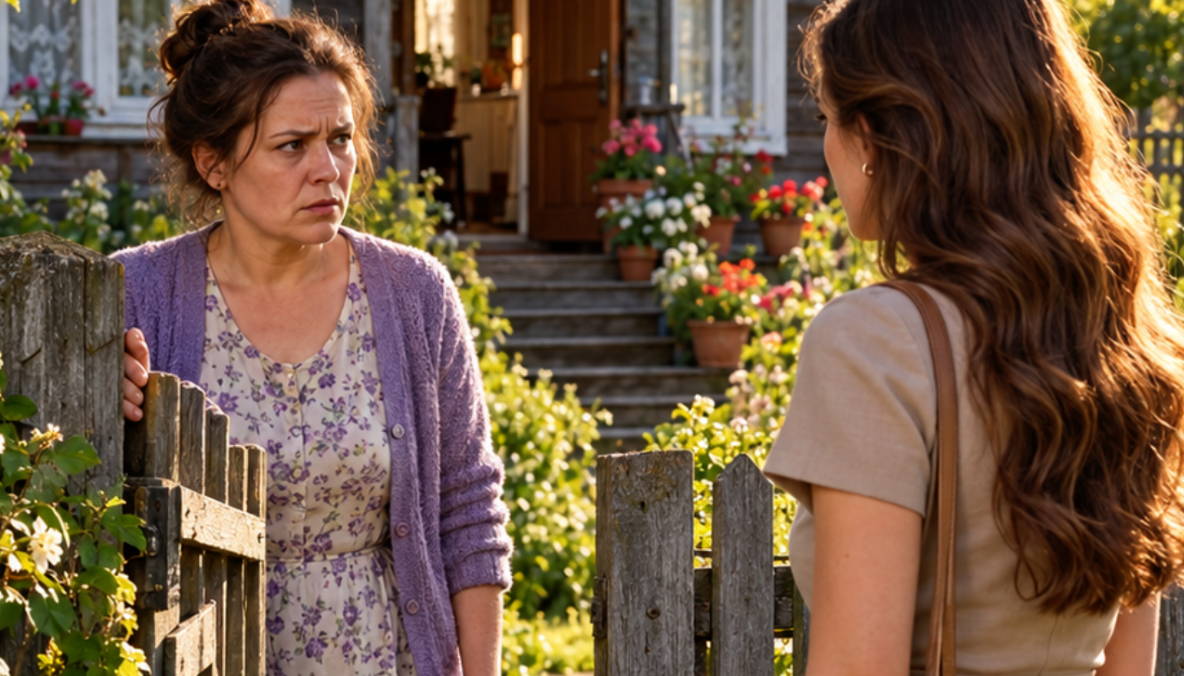
“You’re not coming through this door. This is my home, not a hotel for people who suddenly remembered me after three years.”
Natalia stood in the doorway, gripping the handle so tightly that her knuckles had turned white. On the other side of the porch stood her husband’s sister, Larisa, with two wheeled suitcases and a cardboard box from which the corner of a child’s scooter was sticking out. Beside her, her husband Valera shifted awkwardly from foot to foot, while a little farther away, in the shade of the apple tree, sat Natalia’s mother-in-law, Tamara Petrovna. She watched them as though everything had already been decided and Natalia was merely a temporary obstacle.
The yard was still damp after the morning rain. It smelled of wet earth and flowering tobacco plants, which Natalia had planted along the path during their very first spring there. Three years earlier there had been nothing here—just clay, waist-high nettles, and an old shed that looked ready to collapse from a single push.
And now there was a house.
Her and Sergei’s house.
“Natasha, come on, what are you doing?” Larisa stretched her lips into a smile, but her eyes remained cold. “We’re only here for a minute. We’ll bring our things inside, and then we’ll figure out what to do next.”
“No one is bringing anything into the house,” Natalia said evenly. “Not until I talk to my husband.”
It had all started a week earlier, on an ordinary evening.
Sergei came home from work, put his bag down in the hallway, and let out a very particular kind of sigh. Natalia immediately understood that something had happened. After eight years of marriage, she had learned to read his sighs like weather reports.
One meant he was tired.
Another meant he had argued with his boss.
But this third kind was always about his relatives.
“Mom called,” he said, pulling off his boots. “Larisa and Valera are coming back. For good.”
Natalia froze with the ladle suspended over the pot.
“Coming back from where?”
“From up north. Valera was laid off back in winter, remember? I told you. There’s no work there anymore. They were renting an apartment, but now they can’t afford it. So they decided to come back and live closer to Mom.”
“Closer to Mom,” Natalia repeated.
She put down the ladle and wiped her hands on her apron. Something inside her had already tightened with alarm, as though someone had plucked a stretched string. “But your mother has a two-room apartment, Sergei. A Khrushchev-era flat. She lives there herself, and your grandmother spent her last years bedridden there too. How are all four of them supposed to fit in there? Especially with a child?”
“Well, that’s exactly what Mom was talking about.” Sergei looked away, and from that gesture alone Natalia understood everything before he even said it. “She said our house is big. We have empty rooms. She thought maybe we could help them out, as family.”
There it was.
Natalia sat down on a stool. Outside, dusk was gathering, and the neighbor’s dog lazily barked at someone two houses away.
She looked at her husband and wondered how it had happened that she had foreseen this conversation a year earlier, when she had first heard the word “laid off.”
To understand why everything inside Natalia clenched into a fist, you had to know how this house had come into existence in the first place.
The plot of land had belonged to Sergei’s father, Nikolai Ivanovich. He had been a good, hardworking man who had dreamed his entire life of building a house there for his sons and daughter.
He never had the chance.
After he died, the land was divided among three people: Tamara Petrovna, Sergei, and Larisa.
His mother immediately gave up her share and transferred it to her children. She had put down deep roots in the city, and she did not even want to look at the suburban plot because everything there reminded her of her husband.
Larisa, meanwhile, was preparing to move north. Valera had been offered rotational work there, and according to the rumors, the money was incredible. They needed to travel light, and they needed cash immediately.
So Larisa sold her share.
She sold it to Sergei.
She named the price herself and hurried them along.
“Buy it quickly, or I’ll sell it to someone else. There are interested buyers.”
Natalia had been surprised at the time. What buyers would want a bare patch of clay covered in nettles?
But she said nothing.
Everything was done properly and legally through a notary. The money was transferred, the papers were signed. The contract then went into Natalia’s folder of documents. She was a naturally organized person and kept everything carefully sorted: certificates, receipts, contracts.
It was a habit she had developed back when she worked in accounting.
To pay Larisa for her share, they sold Natalia’s car—a small one, but it had been hers, something she had worked hard to afford.
To begin construction, Natalia sold her room in a dormitory, the only property her parents had left her.
And to pay for the roof, windows, and heating, Sergei took out a loan they were still paying off, saving every kopeck they could.
For three years, they lived in a rented one-room apartment on the outskirts of town.
Natalia worked two jobs.
After his shifts, Sergei didn’t go home—he went straight to the construction site. He carried boards himself, mixed mortar, and laid bricks under the supervision of a contractor he knew.
He came home after midnight, his hands covered in cement, his back so stiff he could barely straighten it.
And what were the relatives doing?
Watching.
Tamara Petrovna called and sighed dramatically.
“Why do you even need that house? You could have lived peacefully in your room instead of exhausting yourselves.”
Larisa sent photographs from the north: a new fur coat, restaurants, captions saying, “Living like normal people.”
Not once did any of them come to help.
Not once did anyone ask whether Sergei and Natalia needed money, an extra pair of hands, anything at all.
Natalia wasn’t offended at the time.
She understood that everyone had their own life.
She simply remembered.
She stored those little details in the same kind of folder where she kept her documents—only this one was internal and invisible.
And now life in the north was over.
The money was gone.
The fur coats, apparently, were no longer enough.
And suddenly blood relatives remembered the large house with its empty rooms.
“Sergei,” Natalia said quietly that evening, “I understand everything. Larisa is your sister, and she has a child. But let’s be honest. This house was built by three of us: you, me, and the bank loan. No one else was standing beside us. And now we’re supposed to let people move in who never lifted a finger to help…”
“But they’re not strangers, Natasha.” Sergei rubbed his face with both hands. “How am I supposed to look Mom in the eye if I refuse?”
“And how are you going to look me in the eye if you agree?”
He didn’t answer.
Natalia remembered that silence too.
The conversation ended without a decision.
Sergei said he would think about it. Maybe they really would find a rental apartment quickly. Maybe they would stay with them for just a week—no longer.
Natalia didn’t believe a single word, but she didn’t push him.
She knew him too well. Whenever his mother was involved, Sergei became deaf and blind to everything else.
And one week later, the suitcases appeared outside their gate.
Natalia stood on the porch, holding the door and looking at the whole group.
Sergei was at work. He had been called in to cover someone else’s shift and wouldn’t be home until evening.
And of course, they had planned it that way.
“Natashenka.” Tamara Petrovna rose from the bench beneath the apple tree, brushed off her skirt, and slowly walked toward the porch with the confidence of someone who believed she had every right to be there. “Why are you standing there like a guard? We’re family. Let them catch their breath after the trip.”
“Hello, Tamara Petrovna.” Natalia didn’t move. “Come in and sit in the yard. I’ll make some tea. But the luggage stays by the gate.”
“What is that supposed to mean?” Larisa released the suitcase handle, and it fell sideways with a thud. “Are we supposed to sleep outside?”
“You’ll sleep at your mother’s place, just as you were staying there before,” Natalia replied. “That was the original arrangement.”
“We never agreed to anything!” Larisa raised her voice, and her normally pleasant face suddenly became hard. “This is my father’s house! Do you understand that or not? My father left us this land! And you’re ordering everyone around here like some kind of queen.”
Here we go, Natalia thought.
“It was your father’s land,” she said calmly, although her heart was pounding. “That’s true. But you, Larisa, sold your share. Three years ago. You sold it yourself for the money you needed before moving north.”
“Sold it?” Larisa drawled contemptuously. “Do you know how much that land is worth now? They built a road here, installed gas, and property prices have tripled! I practically gave it to you for free because we’re family! I could have sold it to strangers for much more!”
“You could have,” Natalia agreed. “But you didn’t sell it to strangers. You sold it to your brother. And you accepted the price you named yourself. The fact that the land became more expensive afterward is neither your achievement nor our problem. You don’t take back something you sold three years later just because its value increased.”
Valera had been standing aside the entire time, staring at the toes of his shoes.
It was obvious that he felt uncomfortable, that the whole idea hadn’t been his and that he had been dragged there.
But he didn’t have the courage to defend Natalia either.
“Natalia, try to understand,” Tamara Petrovna said in a sweet, enveloping voice. “They won’t stay forever. Let the children stay here until Valera finds a job. A month, maybe two. You have all those empty rooms sitting unused. What a waste. Meanwhile, the poor child is suffering in a cramped apartment. Surely you can spare a room for your own niece?”
The child—seven-year-old Dasha—was sitting on her scooter near the gate, poking the ground with a stick.
She clearly didn’t care where they lived.
The adults were simply using her as a shield.
“Tamara Petrovna,” Natalia sighed, “this isn’t about rooms or greed. It’s about the fact that decisions like this are made by the homeowners. Both homeowners. Sergei isn’t here. And until I speak with him, no one is entering the house. This is not up for discussion.”
“He would have agreed ages ago!” Larisa burst out. “You’re the one filling his head with nonsense! Sergei is kind. He would never leave his own sister out on the street! This is all you. You turned him against us!”
Natalia felt heat rise into her cheeks.
That phrase—“you turned him against us”—felt like a splinter.
As if she weren’t a person with her own opinion, but some kind of witch who had enchanted her husband and separated him from his family.
“You know what, Larisa,” Natalia said more quietly but firmly, “I never turned Sergei against anyone. I simply reminded him whose hands built this house. And what it cost: whose room, whose car, whose three years of life. If that’s what you call filling his head with nonsense, then yes. I’m guilty.”
At that moment, the gate creaked behind the relatives.
Sergei.
He entered the yard, tired, still wearing his work jacket, a bag hanging over his shoulder.
He stopped.
His eyes moved over the suitcases, the box with the scooter, his red-faced sister, his tight-lipped mother, and finally his wife standing on the porch with her hand clenched around the door.
And Natalia suddenly realized:
This was the moment.
Everything that had accumulated over the years—all those invisible folders, all those swallowed grievances and unspoken words—had come together here, in this rain-damp yard between the apple tree and the porch.
Everything would be decided now.
“What’s going on here?” Sergei asked quietly.
“Sergei!” Larisa rushed toward him, and her voice instantly became plaintive and tearful. “Please explain it to her! We came here, and she won’t even let us through the door! With our things, with a child—she’s leaving us outside! You’re not like that. You’re my brother!”
“Son,” Tamara Petrovna joined in, dabbing her dry eyes with a handkerchief, “I don’t even know what to say anymore. I raised you, stayed awake at night for you, and now in my old age I have to watch your wife throw your own sister out. Tell her. Surely you can spare a room for Larisa?”
Sergei was silent.
Natalia stared at him without breathing.
She didn’t know what he would say.
During their eight years together, she had seen him in many situations, but never had he been forced to make a choice quite like this.
His mother and sister on one side.
Her on the other.
He placed his bag on the ground.
Slowly.
Then he walked over to the suitcases and looked at them as though seeing them for the first time.
“So you came here to move in,” he said. “While I wasn’t home. You planned everything.”
“Sergei, well, how else were we supposed to do it?” Larisa said quickly. “You’re at work all day. When are we supposed to catch you…”
“And when I clearly told you, Larisa, that Natasha and I had already discussed this and that you couldn’t move into our house—you just decided not to hear me?”
Larisa stopped short.
“You… you told me that?”
She turned toward her mother.
“Mom, you said he had agreed…”
For a second Tamara Petrovna looked completely lost.
And in that single second Natalia understood everything.
Her mother-in-law had simply lied to her daughter.
She had told Larisa that Sergei didn’t mind.
That his wife was the one being difficult.
That they simply needed to show up, force the issue, and present Natalia with a fait accompli.
“Mom.” Sergei turned toward his mother. His voice trembled, but it didn’t break. “Why did you tell Larisa that I agreed? I never said that. Not to you, and not to her.”
“Well, I… I thought you’d come to your senses,” Tamara Petrovna muttered. “She’s your own flesh and blood. How could you not help…”
“Flesh and blood,” Sergei repeated bitterly. “Mom, where was that flesh and blood three years ago? When I was mixing mortar after my shifts and Natasha was selling the last room she owned so we could pour the foundation? Which one of you came even once? Which one of you picked up a shovel? Which one of you even asked whether we needed money?”
He turned toward his sister.
“Larisa, what did you write to me from the north? ‘Living like normal people.’ Meanwhile, I was drowning in debt. And not once—not once—did I hear from you, ‘Sergei, do you need help?’ And now that things have gone wrong for you, suddenly you remember this was Dad’s property and I’m your brother?”
“Sergei, that’s different…” Larisa whispered.
“It’s exactly the same,” Sergei said. “The only difference is that now you’re the one who needs help instead of me. And I would help you. Do you hear me? I really would. I’d give you money for rent, for a deposit—whatever you need. But moving into a house you never lifted a finger to build and acting like you’re in charge here? No. That’s not happening.”
The yard became completely silent.
Even the neighbor’s dog had stopped barking.
Natalia stood on the porch, her eyes beginning to sting.
But not from hurt this time.
From something else.
From realizing that the man she had married eight years earlier was, for the first time in all those years, no longer standing between her and his relatives.
He was standing beside her.
Tamara Petrovna pressed her lips into a thin white line.
“So that’s how it is.” She shoved the handkerchief into her pocket. “I suppose your mother means nothing now. Your wife is more important. Fine. Live your lives. But remember this, son: you only have one mother. And one sister. Turn your back on us today, and tomorrow, when you need someone, who will you go to?”
“Tomorrow I’ll go to Natasha, Mom,” Sergei said simply. “She won’t turn me away. She hasn’t turned me away for eight years.”
Tamara Petrovna said nothing.
She turned around and walked toward the gate, her back rigid and straight.
Larisa remained where she was for another moment, looking at her brother as though expecting him to change his mind, run after her, and call her back.
He didn’t.
She grabbed the suitcase handle and pulled.
One of the wheels became stuck in the wet soil, and she yanked it harder in irritation.
“Valera, help me already!” she snapped at her husband.
Valera picked up the box and the second suitcase.
As he passed Sergei, he suddenly stopped and muttered without raising his eyes:
“Sorry, brother. I told her we shouldn’t do it this way. She wouldn’t listen.”
And those were the only honest words spoken that entire morning.
Dasha got off her scooter and looked at her mother, then at her uncle and aunt.
“So we’re not going to live here?” she asked loudly.
“No, sweetheart,” Larisa answered, and for the first time her voice genuinely trembled. “We’re going to Grandma’s.”
They loaded their things into the taxi they had called without speaking.
Doors slammed.
The suitcases wouldn’t fit into the trunk, and Valera grunted as he rearranged them.
Tamara Petrovna sat in the front seat and didn’t turn around once.
The car sputtered, pulled away, and disappeared down the newly built road, leaving tire tracks in the drying mud.
Natalia and Sergei remained alone in the middle of the yard.
For a long time, neither of them spoke.
Then Sergei walked over to the gate, took hold of the bolt, and slid it firmly into place with a quiet metallic click.
“You know,” he said without turning around, “the whole way home from work, I kept thinking maybe we really should let them stay. The room is empty, after all. What difference does it make? They’re family.”
“And now?” Natalia asked.
He turned toward her.
His face looked tired, but somehow lighter.
As though a heavy sack he had carried on his shoulders for years had finally been removed.
“Now I think the room isn’t extra. It’s ours. We built it with our own hands. And fairness, Natasha, isn’t about giving everyone everything equally. It’s about protecting what’s yours and not abandoning the people who stood beside you.”
He paused.
“I’m sorry I kept avoiding the issue before. I should have said it clearly from the beginning. You had to stand here alone and defend our gate.”
“You made it in time,” Natalia said. “That’s what matters. You made it in time.”
She came down from the porch and walked over to him.
The yard smelled of wet soil and flowering tobacco plants.
Somewhere nearby, the neighbor’s dog began barking again, practical and familiar, the sound of ordinary home life.
“Let’s go inside,” Natalia said. “I made borscht. It’s probably cold after we spent so long standing out here.”
“Our borscht,” Sergei said with a smile. “In our house.”
They walked toward the porch.
Just before entering, Natalia turned and looked at the closed gate, the taxi tracks, and the apple tree beneath which her mother-in-law had been sitting.
She didn’t feel happy.
There had been no victory here—what kind of victory could there be when you had just sent your own relatives away?
But there was something else.
Something important.
The feeling that she was finally standing on her own land, in her own home, beside a man who had chosen to stand beside her.
That personal boundaries weren’t about selfishness.
They were about respect.
Respect for yourself, for your work, and for your family.
And that a home built with your own hands should not be surrendered simply because someone suddenly remembered you were relatives when they had nowhere else to go.
She closed the door behind her.
Quietly.
Calmly.
Like the owner of her own home.