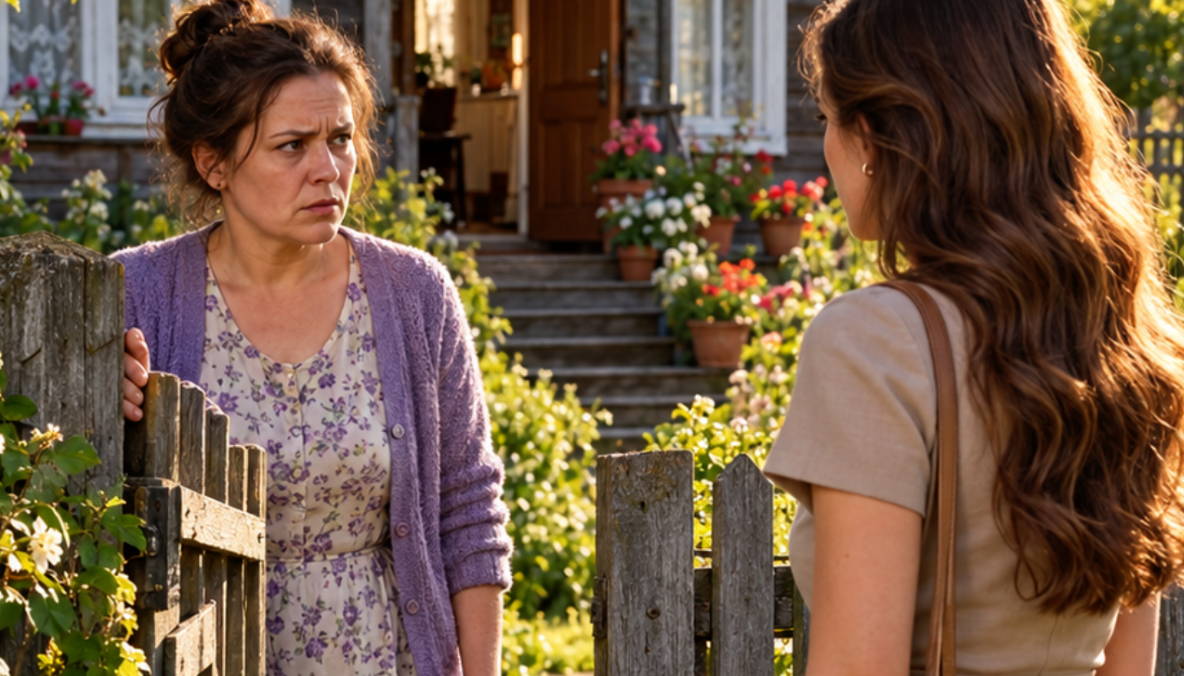
The wife had known for ten years that her husband had a second family while working away from home, but she kept silent—until that family showed up at her house.
Tatiana had known for about ten years.
She knew—and kept silent. Not because she was weak. Not because she was afraid. But because a home had to be held together, and home was the most important thing. That was what her mother had taught her, what her grandmother had taught her, what people in the village had believed for generations: endure it. Eventually, everything will pass.
Her husband, Viktor, would leave for rotational work shifts—or so he said. Up north, at oil fields, one month away, one month home. He would return exhausted, carrying money, hand her his salary card, wash in the bathhouse, and sleep for an entire day. After that, he would sit on the sofa, watch television, and barely speak.
Their children grew up surrounded by that silence. Their son Tolya moved to the capital of the republic, while their daughter Masha got married and lived in the district center. In the large house, only Tatiana remained—and, once a month, Viktor.
Tatiana found out about the other woman by accident.
A neighbor had drunk too much at a celebration and let something slip.
“They say your husband bought a house across the river, in the neighboring district. Lives there with some woman. A young one.”
Tatiana said nothing at the time. She left the table, went out into the vegetable garden, and stood beside the beds for a long time, watching the wind rustle the green tops of the plants.
That evening, after the children had fallen asleep, she walked over to Viktor and asked:
“Vit, is it true? About that woman?”
He turned pale, then red with anger, and finally shouted:
“Who told you? What bastard has been running their mouth?”
And Tatiana understood everything.
He did not deny it for long. Cornered, he admitted it.
Yes, there was a woman. A young woman. Her name was Svetlana. She worked in the local administration. They had met when Viktor was dealing with some paperwork. One thing had led to another.
And they had a daughter.
A little girl named Alisa.
She was four years old.
Tatiana listened while a ringing sound filled her head. It was not even pain that she felt most strongly.
It was humiliation.
For twenty years she had waited for him to come home from his work shifts. She had darned his socks, cooked cabbage soup, raised their children.
And meanwhile, in another district, he had another woman.
And another daughter.
He had named her Alisa.
A beautiful name.
“So what happens now?” Tatiana asked him.
Viktor was silent for a long time.
Then he said:
“I’m not leaving her. And I’m not leaving you. Let’s just keep living. The way we always have.”
And Tatiana agreed.
Not because she forgave him.
Because of the house.
Because of the children.
Because she was ashamed of what people would say.
Because where was she supposed to go at forty-five?
So they continued living like that.
Everything changed one summer afternoon when an unfamiliar car pulled up outside the house.
Tatiana was hanging laundry in the yard. The sun was blazing, and the warm air smelled of heated grass.
She heard the sound of an engine, turned around—and froze.
A woman stepped out of the car.
She was young, around thirty-five, wearing a stylish city dress, high heels, and carrying a fashionable handbag.
Behind her came a little girl, perhaps seven years old, wearing a pink sundress with a bow in her hair.
Tatiana understood immediately.
Her heart skipped a beat.
“Who are you?” she asked, even though she already knew the answer.
“I’m Svetlana,” the woman said with a smile.
The smile was bold and confident.
“And you must be Tatiana? Where’s Viktor?”
Tatiana slowly lowered the wet bedsheet she was holding.
Her hands were trembling.
“He’s at work.”
“That’s a shame,” Svetlana sighed. “We came to see him. He told us you had a house here. We decided—why wait? We should finally meet. This is Alisa. Our daughter.”
The girl looked at Tatiana with large eyes that looked just like her father’s.
And Tatiana saw in that child’s gaze the same confusion she felt herself.
The child was not to blame.
A child was never to blame for any of this.
“Come inside,” Tatiana said quietly. “No point standing at the gate.”
They sat in the kitchen.
Svetlana drank tea, looked around the house, and asked questions.
How long ago had they built it?
Had they built the stove themselves?
Was the vegetable garden large?
Tatiana answered briefly, forcing the words out.
She felt as though she were trapped inside some strange dream.
Her husband’s other family had simply arrived at her house.
Now they were sitting in her kitchen, drinking her tea.
And she, the legal wife, was handing them the sugar bowl.
Alisa wandered around near the window, studying the flowers.
Then she came over to Tatiana.
“Auntie, do you have a cat?”
Tatiana looked at her.
Seven years old.
About the same age as the granddaughter Masha had recently given birth to.
And here stood another daughter of her husband.
Small and innocent.
“Yes,” Tatiana said. “She’s outside. Her name is Murka. Go have a look.”
The girl ran outside.
As soon as Tatiana and Svetlana were alone, Svetlana’s expression suddenly changed.
Her smile disappeared.
“Listen,” she said. “Let’s be honest with each other. I know who you are. And you know who I am. I’m tired of sharing him. He promised me he would leave you.”
“When?” Tatiana asked quietly.
“A long time ago. Back when Alisa was born. But he keeps postponing it. Says there’s the house, the children, that it would be awkward. I’m tired of waiting. That’s why I came.”
Tatiana stared at her, unsure what to say.
“I’m not keeping him here,” she finally said. “He chooses not to leave.”
“Exactly,” Svetlana replied with a smirk. “Because you are keeping him. You and your cabbage soup. And your stove. And this house.”
Tatiana rose from the table.
“This house,” she said, her voice trembling, “I built with him. For twenty years. Every log. Every board. Did you buy it?”
Svetlana stood up as well.
“Do you really think that matters? A house is a house. Love is love. We have love.”
“Love,” Tatiana repeated, shaking her head. “And what kind of father does a child need? One who spends one month here and one month there? He’ll see your Alisa once a month too. Just like he saw my children. Are you ready for that?”
Svetlana fell silent.
Viktor arrived two hours later.
Tatiana had called him as soon as Svetlana crossed the threshold.
She had said only:
“Come home. Your… family is here.”
Then she hung up.
He rushed into the house, sweating and out of breath after arriving by taxi.
When he saw Svetlana and Alisa, he froze.
“You… why did you come here?” he gasped.
“What’s wrong?” Svetlana put her hands on her hips. “You weren’t expecting us? I decided I’m done hiding. Are Alisa and I your family or not? If we are, then everyone should know.”
“Have you lost your mind?” Viktor grabbed his head. “Do you understand what you’re doing?”
“What am I doing?” Svetlana raised her voice. “Showing everyone the truth? Everyone has known it for years anyway!”
At that moment Tatiana entered the room.
She stopped in the doorway.
She looked at her husband calmly.
No tears.
No shouting.
“Vitya,” she said. “Choose. Right here. Right now. Either them or me.”
Viktor’s eyes darted between the two women.
He opened his mouth, then closed it.
There was panic in his eyes.
“Tanya…” he began.
“Don’t ‘Tanya’ me,” she interrupted. “I’m not Tanya to you. I am your wife. Your legal wife. For twenty-eight years. And I waited. I kept waiting for you to come to your senses. I thought you’d get over it. I thought a home was a home and family was family. But apparently you’ve been living between two homes for ten years and thinking that was acceptable.”
She paused to catch her breath.
“It isn’t. You can’t live like this. And I won’t anymore.”
Viktor remained silent.
Sensing something was wrong, Alisa began to cry.
Svetlana picked her up.
“See?” she said to Viktor. “These are your choices. We’re leaving. You decide.”
She turned and walked out.
The little girl buried her face against her mother’s shoulder and sobbed.
The car door slammed.
The engine roared.
Then there was silence.
Viktor and Tatiana were left alone.
“Well,” Tatiana said. “That’s it. Choose.”
Viktor sank into a chair and covered his face with his hands.
“Tanya… I don’t know. I love them. And I love you. I can’t choose.”
“You’re going to have to.”
Tatiana sat across from him.
“Do you know what I realized while the two of you were here… sorting all this out?” she asked. “I realized I am not an object. You can’t keep me in reserve. Like a jar of preserves in the cellar. I am a living person. And I’m tired.”
“Tired of me?” Viktor lifted his eyes.
“Tired of myself,” Tatiana replied. “Tired of the fool who endured this for years and convinced herself that a home was held together by patience. It’s held together by truth, Vitya. And our home has been gone for a long time. A very long time. I was just pretending it was still here.”
She stood.
“Leave. I’m tired. Pack your things.”
“Where am I supposed to go?” he asked, looking around in confusion.
“To her,” Tatiana said. “Since the two of you are in love. Go. There’s a child growing up without her father. Your child too. Go, Vit.”
He stood, hesitated, and took a step toward her.
Tatiana stepped back.
“Don’t. I’m forty-nine years old. It’s too late to hug me now. Too late.”
Viktor left the following day.
He walked out carrying a suitcase, got into a minibus, traveled to the district center, and from there crossed the river into the neighboring district.
To Svetlana.
The house became empty.
Tatiana walked through the rooms, touched the walls, and looked out the windows.
Twenty-eight years.
She had spent twenty-eight years building that home.
And now it was empty.
But strangely enough, she was not afraid.
At first it was difficult.
She would wake in the middle of the night, reach toward the pillow beside her—and quickly pull her hand back.
Empty.
Eventually, she got used to it.
When the children learned what had happened, they came to see her.
Tolya was furious and wanted to go across the river to “have a talk with Dad.”
Masha cried and hugged Tatiana.
But Tatiana calmed them both.
“Don’t. It’s his life. And mine too. I made the decision myself.”
“Mom, how are you really?” Masha asked.
“I’m fine,” Tatiana answered. “I sleep now. For the first time in ten years, I actually sleep. Without that silence. Without knowing something while he doesn’t know that I know. Without all those lies.”
She paused.
“Of course I feel sorry about the house. But walls are just walls. What matters is that I’m alive. And you’re alive. And now everything is honest. That’s worth more.”
Viktor called.
At first, frequently.
Then less and less.
He asked her to take him back.
He said he had made a mistake.
He said things were not working out with Svetlana.
She was young, he complained. She wanted different things. She did not understand him.
Tatiana listened in silence.
“I’m going to sell the house,” she told him one day. “I’ll buy an apartment in the district center. Closer to Masha.”
“And what about me?” Viktor asked.
“You keep living where you live,” Tatiana replied. “You have a daughter there. Alisa. She did nothing wrong. She needs you.”
And Tatiana hung up.
Six months later, she moved.
The apartment was small but bright.
Masha came over often with her granddaughter, and Tolya visited on weekends.
Little by little, life began to settle into a new rhythm.
One day, while sorting through some old belongings, Tatiana found a photograph.
Their wedding picture.
There she was—young and laughing.
Viktor stood beside her, handsome, with a flower in his buttonhole.
They were standing in front of that very house.
It had just been built.
They were happy.
Tatiana looked at the photograph for a long time.
Then she placed it back in the album.
She did not throw it away.
She kept it.
Because the young woman in that photograph was still part of who she was.
And that young man—he had existed too.
Once, he had been genuine.
Something had simply broken along the way.
And the house…
A home is not the walls around you.
A home is where you do not have to remain silent.
Where you do not have to share your husband with another woman.
Where there is truth.