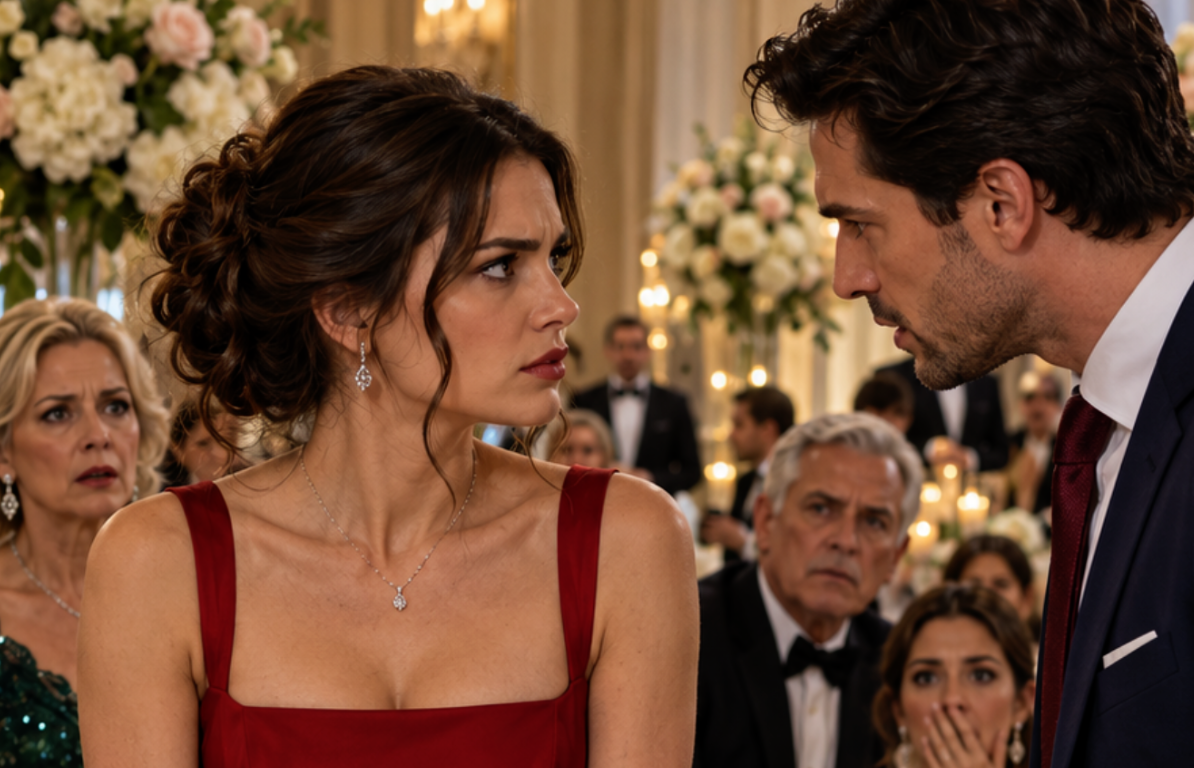
— She seated me at a table in the back so I wouldn’t bother the guests. Ten minutes later, everything changed.
The Veranda restaurant was an expensive place.
I had realized that from the way Vera Pavlovna had been talking about it all week.
“Important people go there.”
“It attracts the right crowd.”
“You can’t just walk in there.”
It was a family dinner with business acquaintances, and she was preparing for it as though it were an important event. Dmitry even bought a new tie.
I wore what I always wore to occasions like this: a dark navy dress, neat and understated. Practical.
I’m a practical person.
Vera Pavlovna was already at the restaurant.
She was standing beside a large table in the center of the dining room, arranging the guests with the solemnity of a conductor taking his place before an orchestra. Oleg and his wife had not arrived yet. Several people in expensive suits were already seated, talking quietly among themselves.
I walked toward the table.
“Marina.” Vera Pavlovna stepped in front of me—not abruptly, but clearly enough to stop me. “People of a certain circle are sitting here. You can sit over there.”
She gestured somewhere toward the back of the restaurant.
“At the far table. You’ll be comfortable there.”
I looked at her.
Then at Dmitry.
He was looking at the menu.
The guests exchanged glances—the ones who had heard her. Someone pretended not to have heard anything.
“All right,” I said.
I picked up my handbag, walked to the back of the room, and sat at a small table against the wall with a single place setting.
I ordered water.
Anna—my friend, who had come with a male friend and happened to be sitting at the next table—looked at me.
I shook my head.
Don’t.
She understood and stayed where she was.
I picked up my phone and checked my messages.
Tomorrow’s surgery was at eight in the morning. A difficult one. I had been thinking about it since morning.
The usual things.
Svetlana entered the restaurant ten minutes later.
I didn’t notice her immediately because my back was turned toward the entrance.
Then I heard her voice.
“Marina Andreyevna!”
I turned around.
Svetlana was walking quickly across the room toward me without looking around.
She was a well-dressed woman in her fifties, with that particular kind of energy you sometimes see in people who have survived something enormous and now enjoy life more intensely than before.
“My God, you’re here!” She came up to me and took both of my hands in hers. “I had no idea you’d be here! Oleg!”
She turned toward her husband.
“Come here!”
The whole room turned to look.
Not all at once, but one person after another.
Her voice carried.
“This is Marina Andreyevna,” Svetlana said, not addressing anyone in particular. She was simply speaking because she was overwhelmed with emotion. “She saved my husband. A year and a half ago. If it hadn’t been for her…”
“Svetlana,” I said quietly. “You don’t have to.”
“Yes, I do!”
She looked at me with an expression that could not be mistaken for anything else.
“You don’t even know what you did for us. Oleg told me how you stood at the operating table for seven hours. Seven hours! And then you came to his hospital room and sat beside him. You just sat there. Not for five minutes—for an entire hour.”
Oleg came over.
The last time I had seen him was a year and a half earlier. Back then, he had been pale after intensive care, surrounded by tubes.
Now he was tanned and strong, with the appearance of a man who valued every single day.
“Marina Andreyevna.”
He didn’t offer me his hand.
He simply nodded—the kind of nod people give when ordinary words are not enough.
“You know.”
“I know,” I said. “How are you?”
“Alive.”
He smiled.
“Thanks to you.”
“Thanks to your heart,” I corrected him. “It wanted to keep beating.”
At the next table, Anna whispered something to her friend.
I couldn’t hear what she said, but I saw her expression.
The entire restaurant was now looking toward our little table by the wall.
Svetlana didn’t leave.
“Would you like to come sit with us?” she offered. “We have a big table. There’s plenty of room.”
“I’m already seated,” I said. “Thank you.”
“But it’s uncomfortable here, in the corner…”
“I’m comfortable.”
She looked at me for a second.
Then she understood something.
I don’t know exactly what, but she understood something.
“Then may we sit with you?” she asked.
Oleg was already pulling over a chair.
“Of course,” I replied.
They sat down.
A waiter came over to move the place settings and add more chairs.
Two guests from the large table—business acquaintances of Oleg’s whom I didn’t know—moved over as well.
Just like that.
Without explanation.
Because Oleg was sitting here, and wherever Oleg sat suddenly became the important table.
Anna leaned toward me.
“Marina, is that the Oleg? The big businessman?”
“That’s him.”
“And he…”
“He’s an ordinary person,” I said. “A person who had a complicated heart condition.”
Vera Pavlovna was watching us from the large table.
I could see her out of the corner of my eye.
I didn’t look at her directly because I didn’t want to turn this into some triumphant moment for myself.
It wasn’t.
It was simply a dinner where I happened to meet a former patient and his wife.
Oleg was telling me about the past year, about his rehabilitation, about how he and Svetlana had gone to the seaside in February and how, for the first time in years, he had swum without being afraid.
I listened.
Svetlana poured the wine.
“I’d like to make a toast,” she said.
She didn’t speak loudly, but in our little corner of the restaurant everyone nearby could hear her.
“To people who choose difficult professions. Not for money and not for status. Because they have the ability to do the work—and because the work needs to be done.”
She looked at me.
“Do you know what she did?” Svetlana asked Oleg’s acquaintances. “She called us a month after the operation. Just to check how Oleg was doing. Not through a secretary. Not through a nurse. She called herself. On a Sunday evening.”
“That’s standard practice,” I said.
“No.”
Svetlana shook her head.
“That isn’t standard practice. That’s you.”
Dmitry moved over to our table.
I hadn’t expected it.
He approached quietly.
I only noticed him when he was already standing next to an empty chair.
He looked at me.
Something in his face was different.
He sat beside me.
He didn’t say anything.
He simply sat down.
Oleg looked at him questioningly, but without pushing.
“My husband,” I explained.
“All right,” Oleg said with a nod.
And he continued the conversation.
Dmitry picked up his glass.
He remained silent.
Then, quietly, almost directly into my ear, he said:
“I’m sorry.”
I didn’t answer immediately.
I thought about it.
“We’ll talk later,” I said.
He nodded.
Vera Pavlovna left before everyone else.
I noticed her out of the corner of my eye.
She stood up and said something to Dmitry.
He shook his head.
She left.
We stayed.
At home, Dmitry answered the phone on the first ring.
“You humiliated me,” Vera Pavlovna said.
I could hear her because he didn’t move the phone away.
“Mom,” Dmitry said. “No. You humiliated yourself. Not me. I sat with my wife. Finally.”
There was a pause.
“Dima! Those people who…”
“Those people chose to sit with Marina themselves because they respect her.”
He spoke calmly.
Unusually calmly.
“Oleg Sergeyevich is an important man. You wanted him to sit with you. He sat with my wife.”
Another pause.
“Good night, Mom.”
He ended the call.
I looked at him.
“You’ve never done that before,” I said.
“I know.”
He sat down at the kitchen table.
“I saw you walking to the corner of the restaurant. One place setting.”
He paused.
“I sat there and pretended I didn’t see it. That’s worse than what my mother did.”
I didn’t argue.
“It is.”
“I know.”
He looked down at the table.
“Marina, I’m going to make things right. Not in one evening. It’ll take time. But I will.”
I looked at this man.
Twelve years together.
He wasn’t a bad man.
He was weak.
Those are different things.
You can hate bad people.
You can’t hate weak people.
You can only grow tired of them.
I was tired.
But not completely.
“All right,” I said. “I’ll see.”
He nodded.
Vera Pavlovna came over a month later.
Without calling first.
That was her habit.
I opened the door, and she was standing there holding a bag.
She had brought something.
At least she hadn’t come empty-handed.
She walked inside and put the bag down.
She looked around.
I put the kettle on.
We sat at the kitchen table.
She looked at me differently than before.
Not critically.
Just… differently.
“Did you really save someone’s life?” she finally asked.
“I’m a cardiac surgeon,” I replied. “That’s my job.”
“No.”
She shook her head.
“I’m asking about that particular man. Oleg… was he really dying?”
“Yes. It was a complicated operation.”
“And you…”
“And my surgical team. We don’t work alone.”
She fell silent.
“I didn’t know.”
“You never asked,” I said.
There was no reproach in my voice.
It was simply a fact.
She lowered her eyes.
“No. I didn’t.”
The kettle boiled.
I poured tea and placed a cup in front of her.
Then I brought out some cookies.
She picked up the mug and held it in both hands, staring into the tea.
“I thought you were just a doctor,” she said. “At some clinic somewhere.”
“I’m a practicing surgeon. Second department.”
“That’s…”
She didn’t finish.
“That’s twelve years of education and about the same amount of practice,” I said. “It’s night shifts. Difficult decisions. It’s patients who sometimes don’t survive despite everything we do.”
I paused.
“Oleg survived. I’m glad.”
Vera Pavlovna drank her tea.
“You never told me any of this.”
“You never asked.”
Repeating it wasn’t cruel.
It was simply true.
She stood up.
Then she opened her bag, took something out, and put it in my refrigerator.
I didn’t look to see what it was.
Then she left.
The next day, I received a message from an unfamiliar number.
A moment later, I realized it was Vera Pavlovna.
She had never texted me before.
She only ever messaged Dmitry.
“Thank you for the tea.”
I stared at the message for a long time.
Then I replied:
“Come again.”
Not “drop by.”
Specifically, “come again.”
An invitation, not permission.
A different choice of words.
Anna called that evening.
“Marina, can I ask you something?”
“Of course.”
“When she made you sit somewhere else… what did you feel?”
I thought about it.
“Hurt,” I admitted. “And tired. It wasn’t the first time.”
“But you didn’t answer her.”
“No.”
“Why?”
“Because I had nothing to prove,” I said. “Anna, every day I do work that matters. That doesn’t depend on which table I’m sitting at.”
“But it felt good, didn’t it?”
“When Oleg stood up?”
I paused.
“Not because Vera Pavlovna saw it. What felt good was seeing him alive. Tanned. Talking about the sea.”
Anna was silent for a moment.
“You’re a good person, Marina.”
“I’m just doing my job.”
“Not just that.”
She paused.
“And Dmitry… did you see his face when he came to sit with you?”
“I saw it.”
“What do you think?”
“I think it’s a beginning,” I replied. “We’ll see what happens next.”
A circle isn’t about money.
It isn’t about connections, status, or a table in the center of an expensive restaurant.
Vera Pavlovna divided the world into “people of a certain circle” and everyone else.
She believed Oleg belonged to one circle, while her daughter-in-law belonged to another—an inferior one.
She wanted to show the “right people” something.
And she did.
Just not what she had intended.
The right people came and sat at the table by the wall.
Because that was where the woman was sitting who had held a living heart in her hands for three hours and refused to let it stop.
I don’t spend my life trying to prove myself.
I do my job.
But your work is also part of who you are.
Perhaps it is the most important thing that defines who you are.
Not your tie.
Not your place at the table.
Not your connections.
What matters is what you do when no one is watching.
Or when everyone is.
That night, Dmitry said he would make things right.
I don’t know how it will turn out.
People change slowly.
That’s true.
But Vera Pavlovna wrote, “Thank you for the tea.”
For her, that was a lot.
I replied, “Come again.”
For me, that was a lot too.
We’ll see what comes of it.
Life is long.
Tell us in the comments: have you ever found yourself in a situation where someone underestimated you, only for everything to turn out completely differently later?