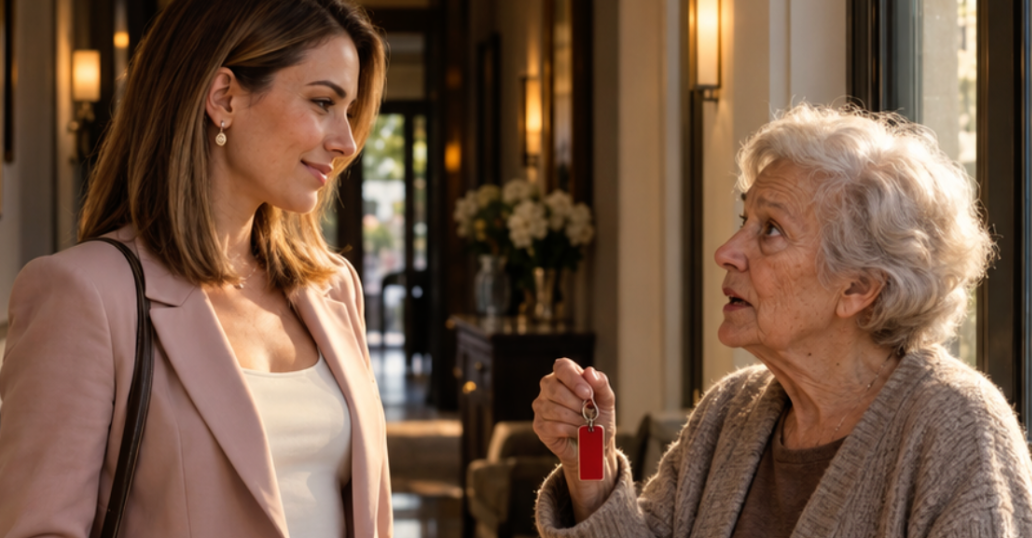
Galina Andreyevna opened the apartment door without knocking, as she always did, and stopped dead on the threshold.
Two suitcases stood against the wall. Beside them were several carefully packed boxes.
“What is this?” she demanded, clutching her key in one hand. “Where are you going, I’m asking you?”
Oksana didn’t turn around.
She was wrapping her restoration brushes in soft cloth and placing them neatly into a box, one after another. Her movements were slow and precise.
“I’m leaving, Galina Andreyevna.”
Her mother-in-law stared at her.
“Leaving? What do you mean, leaving?”
At that moment, Roman stepped out of the bathroom with a towel over his shoulder. When he saw the suitcases, confusion flashed across his face before irritation quickly replaced it.
“Again?” he sighed. “What’s wrong now?”
Oksana straightened and looked at them both.
“Nothing,” she said calmly. “For the first time in years, nothing is wrong.”
Only a few days earlier, she would never have imagined herself saying those words.
Her mornings usually began the same way.
Oksana woke before Roman, made breakfast, prepared his clothes, and tried to keep the apartment quiet and orderly.
That morning, Roman entered the kitchen already annoyed.
“You didn’t iron my white shirt.”
“You wore it yesterday. It’s in the laundry. The blue one is ready.”
Roman slammed the wardrobe door.
“So now I have nothing to wear. Wonderful. What exactly do you do all day?”
Oksana quietly offered to iron the white shirt again.
He waved her away.
“Forget it. You’re useless.”
Years earlier, words like that would have made her cry.
Now they barely surprised her.
On the kitchen table stood an antique walnut box Oksana had been restoring for a neighbor. Its wood had cracked with age, but beneath the damage there was still something beautiful.
Restoration had been Oksana’s passion since she was young.
At first, she repaired old family furniture. Then friends began bringing her things. Eventually, clients found her through recommendations.
People trusted her with objects that carried memories—frames, cabinets, jewelry boxes, old icons.
Roman never respected her work.
“When are you removing this junk?” he asked, looking at the box.
“It’s not junk. It’s an order.”
He laughed.
“You play with old furniture and call it work. I pay for this apartment. I pay the bills. Your little hobby barely contributes anything.”
Oksana turned away.
Arguing was pointless.
Roman had stopped listening to her years ago.
The apartment itself belonged to him. He had inherited it before their marriage, and both Roman and his mother made sure Oksana never forgot it.
Galina Andreyevna even had her own key.
“This is my son’s apartment,” she would say whenever Oksana objected. “I don’t need permission to visit my own son.”
One afternoon, Nina Sergeyevna, the neighbor whose box Oksana was restoring, came downstairs.
When she saw the restored wood, she smiled with delight.
“It looks wonderful!”
Then she studied Oksana’s face.
“Oksana, forgive me for interfering, but these walls are thin. I hear how Roman talks to you.”
Oksana looked down.
“It’s a family matter.”
Nina Sergeyevna sighed.
“I lived with my husband for forty years. We argued too. But humiliating someone every day is not marriage.”
Those words stayed with Oksana.
That evening, Roman returned home late.
There was a sweet perfume on his jacket—a scent Oksana had never worn.
When she picked up the jacket to hang it, something fell from the pocket.
A thin gold chain.
The pendant was shaped like the letter V.
“Roman,” she called. “What is this?”
His expression changed instantly.
“A colleague asked me to repair the clasp.”
“A colleague?”
“Yes. Why are you interrogating me?”
“I’m just asking.”
“You’re always looking for problems. Stop going through my things.”
He took the necklace and walked away.
Oksana remained standing there.
It wasn’t only the necklace.
It was the perfume. The late evenings. The phone Roman had recently started keeping face down.
And most of all, it was how easily he lied.
Two days later, Galina Andreyevna appeared unexpectedly while Oksana was working.
She wrinkled her nose.
“That smell again. This is a home, not a workshop.”
“I’m almost finished.”
“You’re always almost finished. Maybe if you paid more attention to your husband, he wouldn’t be looking elsewhere.”
Oksana froze.
“What did you say?”
Galina Andreyevna suddenly became uncomfortable.
“Nothing. Forget it.”
But Oksana had already understood.
Her mother-in-law knew.
Not only did she know about another woman, she apparently believed it was Oksana’s fault.
The truth became undeniable the following day.
Oksana returned home earlier than expected and heard Roman talking on the phone inside the apartment.
He hadn’t closed the door properly.
“Don’t worry,” he was saying. “Oksana is just a habit. Where would she go? She can’t live on those wooden things. She’ll tolerate it.”
Oksana stopped breathing.
Then Roman laughed softly.
“My mother knows. She says it’s probably for the best. I’ll see you tonight.”
Oksana stood in the hallway, strangely calm.
Roman believed she was trapped.
He believed she had nowhere to go.
That evening, she called her sister Lena.
“Can I stay with you for a few days?”
“Of course,” Lena answered immediately.
The next evening, sitting at her sister’s kitchen table, Oksana told her everything.
To her own surprise, she wasn’t devastated.
“I thought finding out about another woman would destroy me,” she admitted. “But instead I feel relieved.”
Lena squeezed her hand.
“You’ve been walking on eggshells for years.”
Oksana watched Lena’s husband come into the kitchen and casually ask where his phone charger was.
Lena pointed toward the living room.
“Thanks,” he said.
That was all.
No criticism. No sarcasm.
No tension.
Oksana suddenly realized how abnormal her own marriage had become.
The following day, she returned to Roman’s apartment to collect her belongings.
Documents went into one folder.
Clothes into suitcases.
Tools into boxes.
She packed her brushes carefully, as if she were preparing them for a new life.
Then the door opened.
Galina Andreyevna walked in.
“What is all this?” she exclaimed. “Where are you going?”
“I’m leaving.”
Roman appeared behind her.
When he saw the suitcases, he laughed.
“And where exactly will you go? What will you live on? Those little boxes you repair?”
Oksana looked directly at him.
“I heard your phone conversation.”
His smile disappeared.
“What conversation?”
“The one where you called me a habit. The one where you said I had nowhere to go.”
Roman went pale.
“You were listening to me?”
“The door was open.”
Galina Andreyevna looked nervously between them.
“What is she talking about?”
“Ask Roman about the woman whose name starts with V,” Oksana said. “Although you already know, don’t you?”
Her mother-in-law fell silent.
Roman tried to recover.
“It isn’t what you think.”
“It doesn’t matter anymore.”
Oksana closed her suitcase.
“For seven years, I lived in a home where everything reminded me I didn’t belong. My work was called rubbish. My opinions didn’t matter. Your mother walked in whenever she wanted. And you treated me like someone who should simply be grateful you allowed her to stay.”
Galina Andreyevna raised her voice.
“How dare you speak about our family like that!”
Oksana turned toward her.
“Because I’m no longer afraid of you.”
Then she took the apartment key from her pocket and placed it on the cabinet.
“You can have your son back.”
Roman suddenly stepped toward her.
“Oksana, wait. Let’s talk.”
She looked at him and felt something surprising.
Nothing.
No rage.
No heartbreak.
Only relief.
“I’m going somewhere I don’t have to be tolerated.”
Then she picked up her suitcase and left.
A week later, Oksana rented a small apartment.
It wasn’t luxurious, but it had large eastern windows and a tiny balcony.
She turned the balcony into a workshop.
Her tools were placed exactly where she wanted them. Her brushes were lined up beside the window. Jars of varnish stood openly on the shelves.
No one complained.
No one called them junk.
Nina Sergeyevna recommended Oksana to several friends, and soon the orders started coming.
An antique dresser.
A carved mirror frame.
An old family icon.
A complicated Karelian birch box.
For the first time, Oksana had enough space, time, and silence to work properly.
The divorce was finalized two months later.
Roman had already moved in with the woman whose name began with V.
Oksana wished them well.
When she walked out of the courthouse, Lena was waiting outside.
“So?” Lena asked.
Oksana smiled.
“I’m free.”
A year later, Oksana’s restoration business was thriving.
People contacted her from other cities. She had regular clients, steady income, and enough savings to begin thinking about buying her own apartment.
One evening, Nina Sergeyevna visited her workshop.
She looked around at the tools, polished furniture, brushes, and warm evening sunlight.
Then she looked at Oksana.
“You’re different now,” she said. “Your eyes look alive.”
Oksana smiled.
“I feel different.”
After Nina Sergeyevna left, Oksana stepped onto the balcony.
On the table stood an antique mahogany writing desk she was nearly finished restoring.
She ran her hand over the smooth wood.
Over the years, she had repaired hundreds of damaged things.
Things people had believed were too old, too broken, or no longer valuable.
She had carefully removed the damaged layers, repaired the cracks, restored the structure, and brought the beauty back.
Oksana smiled at the thought.
In a way, she had finally done the same thing for herself.
Below, children were laughing in the courtyard.
The evening air smelled of lilacs.
For the first time in many years, Oksana felt completely at peace.
Her life was no longer something she had to endure.
It belonged to her.
And this time, she intended to live it exactly the way she wanted.