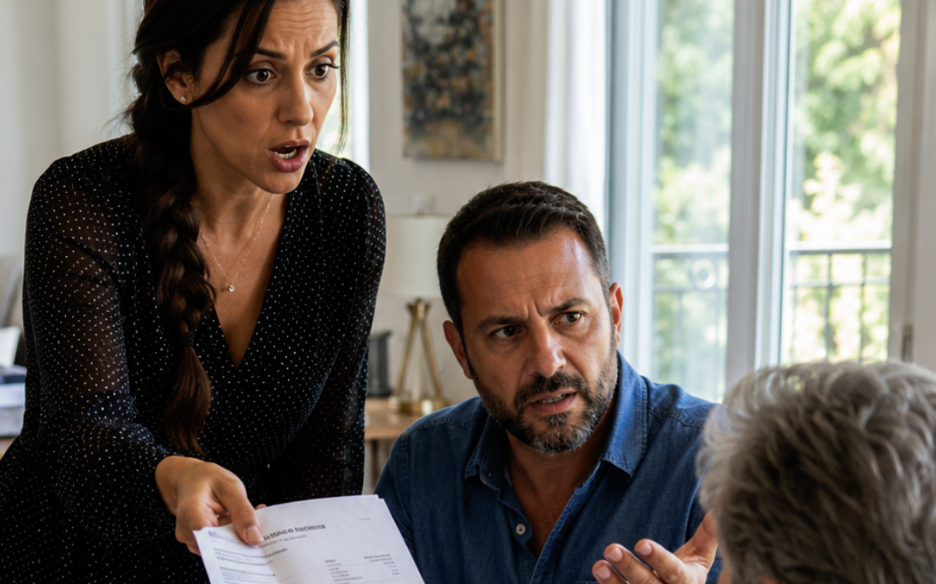
“Now you won’t be explaining the missing money to me. I’m no longer interested in your fairy tales,” the daughter-in-law declared, throwing the bank statement onto the table.
After her parents’ funeral, Valeria was left completely alone. She had no close relatives—no brothers, no sisters, no grandparents she could turn to for support. She did not want to sell her parents’ three-room apartment, but living there alone, surrounded by things that held too many memories, proved impossible.
It took almost six months to find a buyer. The neighborhood was not particularly desirable, the building was old, and the realtor kept warning her not to expect a quick sale. Eventually, however, the apartment was sold, and a substantial sum was deposited into Valeria’s personal bank account—the last material thing she had left from her parents.
Valeria had no intention of spending the money right away. She planned to find a home of her own—slowly, thoughtfully, without rushing or making compromises—and until then, she intended to keep the money untouched in her account. Every evening she looked through listings, went to apartment viewings, and compared neighborhoods, but she could not seem to find the right place. Either she disliked the layout, the floor was unsuitable, or the price was far too high for the condition of the property.
At first, Valeria’s husband, Vladimir, showed no particular interest in the money—at least not openly. But gradually, month after month, cautious hints began creeping into their conversations.
“Listen,” he said one evening over dinner, “maybe we could use some of that money for something we both need? The apartment could use renovations, and we’ve needed a new car for ages.”
“Vladimir, it’s my inheritance,” Valeria replied evenly every time he brought it up. “The money is set aside for an apartment. I’m not touching it until I buy a place.”
At first, her husband agreed, nodded, and did not seriously argue.
His mother, however, was far more persistent.
Larisa Gennadyevna was a decisive woman who was accustomed to having her opinion treated almost like law within the family.
“I simply don’t understand this obsession with independence,” her mother-in-law would declare at nearly every family dinner while cutting a pie into neat slices. “It’s a serious amount of money, yet Valeria controls it entirely by herself, as though she doesn’t even have a husband. My Vladimir is practically living like a tenant next to a wealthy wife—no property of his own and no say in family matters.”
“Mom, enough already,” Vladimir sometimes tried to object during the first few months. “It’s her money. It came from her parents. What right do I have to claim it?”
“Married couples should decide everything together!” Larisa Gennadyevna insisted. “Just look at her—keeping a separate account as though she isn’t married at all.”
Valeria listened to such conversations with outward calm, although irritation built inside her every time. Her parents had been dead for less than a year, yet her mother-in-law was already openly discussing their inheritance as though it belonged equally to the whole family.
“Larisa Gennadyevna,” Valeria always replied in the same even tone, “that money is intended for my future home. Until I buy an apartment, I’m not touching it. I’m sorry, but the decision is final.”
Her mother-in-law would purse her lips unhappily and shoot a sharp glance at her son, as though demanding that he take more decisive action. She would stop arguing aloud—until the next dinner, when the conversation inevitably returned to the same subject.
Gradually, Vladimir’s position began to change.
It happened almost imperceptibly, but steadily.
He stopped objecting to his mother almost completely, and at home he increasingly repeated her arguments nearly word for word, as though he had adopted her opinions as his own.
“Valeria, what if we actually think about this seriously?” he would say again and again. “That money is just sitting there doing nothing when it could be helping the family right now.”
“Vladimir, I’ve already explained this a hundred times,” his wife answered wearily. “I’m not touching my inheritance until I buy an apartment. This isn’t up for discussion.”
Her husband would frown and back off temporarily, but his interest in the balance of the account did not disappear. On the contrary, it only grew stronger.
Several times Vladimir asked Valeria to show him the balance in the banking app, supposedly out of simple curiosity.
“Come on, just show me. What’s the big deal?” he persuaded her with forced casualness. “I’m just curious how much is actually left from the sale.”
Valeria refused each time—not because she suspected him of anything specific, but simply because she regarded the exact figures as her private business, something that did not need to be discussed with anyone else.
Vladimir’s excessive curiosity disturbed her vaguely, somewhere deep in the back of her mind, but at the time she saw no concrete reason to worry.
The strange problems with her phone started about two weeks later.
Her old smartphone, which she had bought around five years earlier, began freezing regularly. The banking app would not always open on the first try, messages sometimes arrived several hours late, and occasionally the screen stopped responding altogether, forcing her to restart the device several times in a single evening.
“Just buy yourself a new phone already. Why are you putting yourself through this?” Vladimir advised irritably one evening as his wife once again tried to restart the frozen banking application. “Your money isn’t going anywhere while you’re looking for an apartment. Why are you so worried about an old piece of hardware?”
Valeria, absorbed in searching for a home and still struggling with the loss of her parents, kept postponing replacing the phone. It seemed unimportant. She would deal with it when she had more free time.
The truth came out on an ordinary weekday evening.
Valeria returned from yet another apartment viewing and decided to check her account balance. She wanted to calculate whether the apartment she had just seen fit within her budget.
The app struggled to open but finally loaded.
The number on the screen took her breath away.
The account was almost empty.
Instead of the large sum that should have been there, only a ridiculous amount remained.
When she tried to open the transaction history, the phone froze again. The screen turned white and stopped responding to every touch.
Trying to remain calm, Valeria showed the phone to her husband.
“Vova, look,” she said, her voice trembling despite herself. “There’s almost no money left in the account. Where did it go?”
Her husband’s reaction was unexpectedly aggressive.
There was no sympathy.
No surprise.
Instead, he immediately accused her, almost as though he had prepared his response in advance.
“Maybe you transferred it somewhere yourself and forgot!” Vladimir nearly shouted. “You’re always having problems with that phone. Who knows what you might have pressed accidentally!”
“I didn’t transfer anything anywhere,” Valeria said as she felt heat slowly rise into her face. “At least help me figure it out instead of immediately accusing me!”
“I’m not helping you with anything,” her husband snapped, turning away. “As far as I’m concerned, you’re putting on some kind of performance. You want to accuse my mother of everything and destroy the family? Then just say it directly instead of pretending to be a victim!”
Valeria stood frozen for several seconds, staring at her husband as though she were looking at a complete stranger.
There was no point continuing the conversation.
Vladimir clearly had no intention of helping her investigate what had happened. He was only defending himself, even though he had barely listened to her explanation.
Valeria hardly slept that night.
Early the next morning, as soon as the bank branch opened, she went there personally to discover the truth.
After listening to her explanation, a bank employee printed the complete transaction history for the previous month.
“Here, look,” the employee said, pointing to one line on the statement. “Almost the entire amount was transferred in a single transaction to a card registered in the name of Larisa Gennadyevna. And there’s something else. The banking app was accessed from another device when the transfer was made—not from yours.”
“Another device?” Valeria repeated, not immediately understanding the significance of what she had heard. “How is that even possible if I’m the only person who knows the password?”
“It’s possible if someone had access to the confirmation code,” the employee explained. “Usually, the SMS is sent to your phone number. If your number was somehow duplicated onto another SIM card, the second phone could receive the confirmation codes as well.”
Valeria suddenly remembered all the strange glitches.
Her phone freezing precisely when important messages should have arrived.
SMS messages appearing hours late.
The unusual problems with the network during the previous few weeks.
Everything suddenly began fitting together.
Following the bank employee’s advice, Valeria immediately contacted her mobile provider and requested a record of any duplicate SIM cards that had been issued for her phone number.
It turned out that one month earlier, someone had requested a replacement SIM card at one of the provider’s stores, supposedly because the original had been lost.
A copy of Valeria’s passport had been presented.
Of course Vladimir had access to copies of her documents.
Like many married couples, they had kept Valeria’s passport and other family documents together for years in a shared folder at home that both of them could access.
After obtaining the duplicate SIM card, Vladimir had begun receiving all the SMS messages and confirmation codes intended for his wife.
Meanwhile, because of the conflict between the two SIM cards, Valeria’s original SIM began functioning unpredictably.
That explained the constant delays and connection problems she had mistakenly blamed on her aging smartphone.
Valeria returned home with the printed bank statement in her bag, no longer doubting that her husband and mother-in-law had been involved in the disappearance of the money.
She found both of them at home.
Vladimir and Larisa Gennadyevna were sitting in the kitchen, and judging by their tense expressions, they were already preparing themselves for another round of denials and excuses.
Valeria silently walked over to the table and placed the banking documents directly in front of them.
“Now you won’t be explaining the missing money to me. I’m no longer interested in your fairy tales,” the daughter-in-law declared, throwing the statement onto the table.
Larisa Gennadyevna flinched but recovered almost immediately and went on the offensive.
“This must be some mistake by the bank!” her mother-in-law exclaimed, raising her voice. “Who knows what they mixed up with the transfers? Systems are failing everywhere nowadays!”
Vladimir grabbed the printout, quickly scanned the pages, and tried to make his voice sound confident.
“These papers don’t prove anything,” he declared, tossing them back onto the table. “The bank can print whatever it wants. None of this proves anything legally.”
“Doesn’t prove anything?” Valeria repeated, feeling an icy calm rising inside her, far more frightening than ordinary anger. “Your mother’s account is written there in black and white, Vladimir. And there’s also the duplicate SIM card that was issued in my name without my knowledge.”
“Do you even understand what you’re doing?” her husband exploded. “You want to get my mother prosecuted over some money? Instead of calmly sorting this out, you immediately ran to the bank and created a scandal!”
“You two created the scandal,” Valeria answered evenly, “when you decided you could simply take my inheritance without asking me.”
Larisa Gennadyevna, who until then had tried to maintain the appearance of outraged innocence, suddenly changed her tone.
It was almost as though she had grown tired of pretending.
“So what?” she said defiantly. “Vladimir is just as much an heir as you are, by the way. A husband is a husband. He has every right to part of the money left by his wife’s deceased relatives!”
“He has no such right,” Valeria said, shaking her head. “The inheritance belongs personally to me and was legally registered only in my name. It was never marital property.”
“Oh, enough already,” Vladimir snapped. “You’d think you were going to starve without that money! I gave part of it to Mom, and the other part I was planning to…”
He stopped in the middle of the sentence.
But it was already too late.
Valeria sharply raised her eyes toward him.
“Part?” she repeated slowly. “You just said ‘part,’ Vladimir. I never told you or your mother the amount that was transferred. How do you know exactly how much was taken if you had nothing to do with it?”
Silence fell over the kitchen.
It was a confession far more convincing than any words could have been.
Vladimir turned pale.
He tried to say something but stopped, realizing that he had accidentally exposed himself completely.
There was no longer any point in denying anything.
Without another word, Valeria left the kitchen, picked up her phone, and returned.
Then she read aloud the short message she had sent to the police reporting the unauthorized transfer of her money.
“You seriously decided to involve the police?” Vladimir jumped to his feet, losing the last of his self-control. “You’re willing to destroy the family over money?”
“You destroyed the family,” Valeria replied calmly, without a single tear, “the moment you obtained a duplicate of my SIM card and transferred my dead parents’ money into someone else’s account.”
Larisa Gennadyevna attempted once more to talk about a supposed banking error, but her voice was no longer nearly as confident.
Her eyes darted nervously between her son and daughter-in-law, searching for support that was nowhere to be found.
That same evening, Valeria filed an official claim seeking the return of the illegally transferred money.
At the same time, she began preparing the documents for divorce.
After such a betrayal, staying married made absolutely no sense to her, nor did she have the slightest desire to remain with Vladimir.
The legal proceedings dragged on for several months.
The investigation confirmed that the duplicate SIM card had been obtained fraudulently using someone else’s passport information.
The bank transfers were ruled unauthorized, and the court ordered Larisa Gennadyevna to return the entire stolen amount in full, along with additional compensation for the damage caused.
Vladimir himself faced criminal charges for using another person’s personal information and committing fraudulent transactions involving his wife’s bank account.
The divorce was finalized without much difficulty.
There was almost nothing to divide except their mutual accusations.
According to rumors that later reached Valeria through mutual acquaintances, Vladimir was left without a family and without his former reputation at work.
After the story became public, he was forced to resign from his job, while the very real possibility of a criminal conviction now hung over every step of his future.
Valeria, meanwhile, waited until the money had finally been returned through the court.
Then she found the apartment she had been searching for.
It was small but bright, located in a peaceful neighborhood not far from the park where her parents had once taken her for walks when she was a child.
As she moved into her new home, for the first time in a long while, Valeria felt something other than the pain of loss.
It felt almost like closure.
As though the final obligation she owed to the memory of her parents had finally been fulfilled properly, despite everything she had been forced to endure along the way.