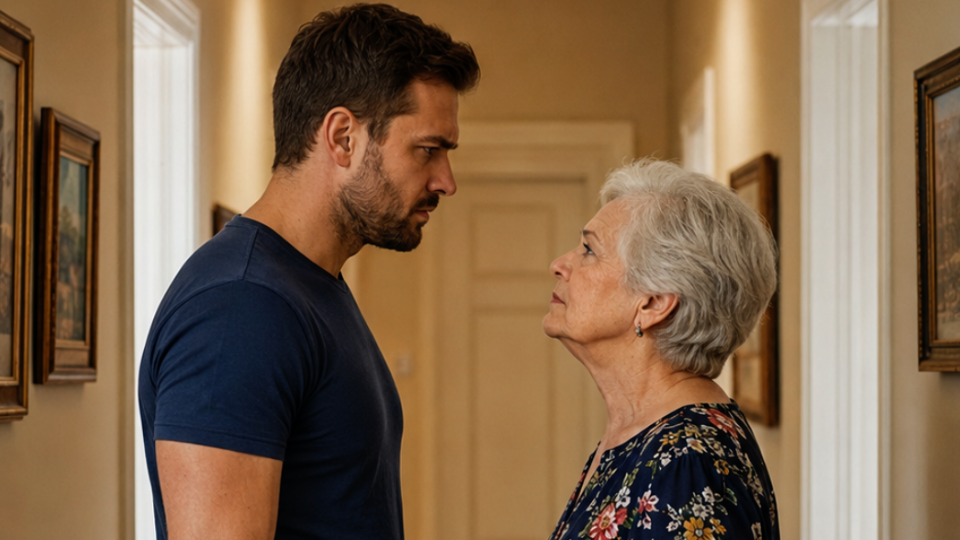
— Mom, could you stop constantly interfering in my family and insulting my wife? Do you even understand what you’re doing?
— So, you didn’t even manage to wipe the dust all day?
Lyudmila’s voice, dry and prickly like last year’s grass, sliced through the midday silence of the kitchen. Katya did not turn around. She continued chopping beets for the borscht, and the steady tap of the knife against the cutting board was her only answer. She had long ago learned this silence. It was her armor, her only protection from the poison her mother-in-law brought with her every time she opened the door to their apartment with her own key. Stas was at work. Lyudmila always came when Stas was at work.
— I don’t understand what you even do here all day. — Lyudmila would not let up. She went into the living room, and Katya could hear her heavy, inspecting footsteps across the parquet floor. — Your husband works himself to the bone, provides for the family, while she sits within these four walls. No comfort, no cleanliness. My poor boy.
Katya pressed the knife blade hard into the firm flesh of the beet. Juice, dark as venous blood, splashed across the board. Poor boy. This “poor boy” was thirty-two years old, headed a department at a large company, and earned three times more than his mother received from her respectable pension. But to Lyudmila, he would always remain her little Stas, her treasure, treacherously stolen away by this lanky, silent girl with empty eyes.
At first, Katya had tried. She tried to smile, joke things away, and please her. She baked her favorite pies, bought her medicine, and spent hours listening to stories about neighbors and illnesses. But it was useless. Every action, every word Katya said passed through a filter of malice and was interpreted in the worst possible way. The pie was too bland. The medicine was fake. The smile was insincere. Eventually, Katya gave up. She simply stopped reacting, turning herself into another piece of furniture in her own apartment.
— And what is this slop? — Lyudmila suddenly appeared in the kitchen doorway again. She looked into the pot on the stove, and her face twisted into a disgusted grimace. — You call this borscht? It’s just water with vegetables. The dogs in my yard eat better than this.
Katya slowly put down the knife. She wiped her hands on a towel, turned around, and looked directly at her mother-in-law without lowering her gaze. Something inside her had stretched to its limit, like a thin, overheated string ready to snap at any moment. She remained silent, but her silence was louder than any scream. It contained everything: months of humiliation, swallowed insults, and exhaustion that had seeped into her very bones.
That calmness, that cold detachment, finally drove Lyudmila into a fury. She was used to arguments, tears, and excuses. They gave her energy and confirmed her power. But this silence disarmed and insulted her.
— What are you staring at me for? Do you think I don’t see how you’re turning him against me? — she hissed, taking a step forward. — Do you think I don’t understand that all you want is his apartment?
Katya did not move. She continued looking into those eyes burning with malice, and the faintest bitter smirk appeared on her lips.
That smirk became the detonator.
Lyudmila’s gaze darted across the table. Her hand jerked out and grabbed the very knife Katya had just put down. The wooden handle settled firmly into her palm. She stepped closer, holding the knife out in front of her like a scepter.
— I’ll teach you to respect your husband! — she growled, and now there was more than anger in her voice. There was genuine, animalistic hatred.
At that moment, the string inside Katya snapped. But not with a sharp ring—with a dull, heavy sound. All fear and confusion disappeared, replaced by icy, absolute calm. She looked at the knife, then back at her mother-in-law’s face.
And she understood that this was the end.
Not the end of her life.
The end of her patience.
Coldly and firmly, as though speaking to an annoying street vendor, she said two words:
— Get out.
Lyudmila was stunned. She froze with the knife raised, unable to believe what she had heard.
— Leave. Right now, — Katya repeated, and there was neither fear nor anger in her voice.
Only steel.
She walked around the table, opened the front door, and stood beside it, waiting. Her posture, her gaze, her entire presence radiated such unyielding determination that Lyudmila involuntarily backed away. She lowered the knife, threw it onto the table with a loud clatter, hissed something unintelligible, and stumbled out onto the landing.
Katya did not wait for her to call the elevator. She slammed the door shut and turned the key in the lock.
Twice.
Then she walked to the phone.
Her hands were not shaking.
— Stas, your mother came over today.
Katya’s voice over the phone was steady, almost official. Stas was sitting in a meeting, absentmindedly drawing meaningless squares in his notebook while listening to a colleague’s tedious report. He pressed the phone to his ear, turning away from the table, and immediately fell out of the monotonous rhythm of the office.
There was no complaint in his wife’s voice. No accusation.
That was exactly what struck him like an alarm bell.
People did not complain like that.
That was how someone reported an emergency.
— And? — he asked, and his own voice sounded unfamiliar to him.
— She picked up a knife from the table and threatened me with it. She didn’t do anything. I asked her to leave. She left.
Short. Factual. Without details that could be dismissed as female emotion.
Only the dry essence of an event that sent a chill down his spine.
A knife.
Not shouting. Not a scandal. Not a broken plate.
A knife.
The word hung between them in the silence of the phone call, solid and real. He looked at his colleagues discussing quarterly figures and suddenly felt as though the world around him had become flat and made of cardboard. Reality was there, in the phone, in the three short sentences spoken by his wife.
— I’m coming, — he said, and hung up without waiting for an answer.
He stood. Silently gathered his laptop and notebook from the table, nodded to the department head, and said:
— I urgently need to leave.
Without explaining why, he walked out of the conference room.
His movements were precise and economical, without any fuss. There was no explosion inside him. Instead, something heavy and icy slowly began spreading through his veins.
It was rage.
But not hot, burning rage.
Cold rage, like liquid nitrogen.
The kind of rage that did not cloud the mind but sharpened it to an almost painful clarity.
The drive to his mother’s apartment became torture. The red brake lights ahead merged into one irritating streak. The city noise pressed against his ears. And in Stas’s mind, the last year and a half of his life with Katya replayed like a recording on fast-forward.
Suddenly, he saw clearly everything he had stubbornly refused to notice.
There was Katya during the first months after their wedding, cheerful and laughing, excitedly telling him how his mother had visited and how the two of them had baked pies together.
And then there was Katya six months later, answering his question, “Did Mom stop by?” with a short “Yes,” immediately changing the subject.
He had watched the light gradually disappear from her eyes. He had seen her shoulders droop more often. He had noticed how she flinched when the phone rang at unusual times.
He had seen all of it.
But he had blamed exhaustion, the difficulties of adjusting to married life, his mother’s “difficult personality.”
He had been a convenient idiot in his own life.
His mother’s casually thrown remarks at family dinners surfaced in his memory:
“Stas, you’ve lost weight. Doesn’t she feed you at all?”
“Katya is certainly a striking girl, but she was never taught how to keep a home.”
He had taken it all for harmless grumbling, an aging mother’s jealousy.
Now those words assembled themselves into a clear, deliberate system of harassment.
It had not been concern.
It had been war.
A war his mother had been waging on his territory, using his wife as the target.
And worst of all, through his inaction and his constant desire “not to make a big scandal out of it,” he had supplied that war with ammunition.
He gripped the steering wheel so hard that his knuckles turned white.
The knife.
That detail would not leave his mind.
This was no longer ordinary domestic intimidation. A line had been crossed, and beyond that line lay madness.
And he, Stas, had allowed it to happen.
He had failed to protect her.
He had failed to keep her safe.
Guilt burned through him but immediately transformed into cold, steely determination.
He turned into the courtyard of the familiar five-story apartment building from his childhood.
There were her windows.
Once, they had glowed with warmth and comfort for him, with the smell of sweet cheese pastries and the feeling of safety.
Now he looked at them like firing ports in an enemy fortress.
He parked the car and turned off the engine. For several seconds he sat motionless, staring straight ahead.
He had not come here to talk.
Not to sort things out.
He had come to end this war.
Once and for all.
He got out of the car.
Every step across the cracked asphalt toward the entrance was firm and measured. He climbed the stairs, and the sound of his shoes against the concrete steps echoed through the empty stairwell like a countdown before a sentence was carried out.
He stopped in front of the familiar door.
And raised his hand to the doorbell.
The door opened almost immediately, as though Lyudmila had been standing behind it waiting.
Her face already wore a carefully prepared mask of suffering righteousness, her eyes ready to fill with offended tears.
When she saw her son standing there, her lips curled into a triumphant, sorrowful smile.
At last.
Her boy had come to rescue his mother from the monster he had brought into their family.
The familiar childhood smell of the apartment struck Stas: a mixture of Corvalol, dusty fabric, and something sweet and sour baking somewhere inside.
— Stas, finally! You have no idea what that—
He did not let her finish.
He simply stepped over the threshold, forcing her to retreat farther into the hallway, and his voice—low and solid as stone—cut through her prepared speech.
— Mom, could you stop constantly interfering in my family and insulting my wife? Do you even understand what you’re doing?
The question fell into the stale hallway air, and the entire scene Lyudmila had carefully prepared collapsed.
The mask of wounded innocence vanished from her face, revealing pure, undisguised astonishment.
She stared at him as though her beloved dog had suddenly begun speaking fluent Latin and accusing her of heresy.
Her Stas.
Her boy.
He had not come to defend her.
He had come to confront her.
— What? — she asked again, and there was already steel in her voice. — How dare you… Did she go crying to you? That little actress? I knew it! The moment I try to teach her some sense, she immediately runs to you to complain!
— Teach her? — Stas took another step forward, and Lyudmila instinctively pressed herself against the wall.
He did not shout.
He spoke in the same flat tone, and that steady, merciless voice was more frightening than yelling.
— You call that “teaching” her? You grabbed a knife, Mom. You threatened my wife. In my home.
Lyudmila pushed herself away from the wall. The shock on her face turned into fury. Blood rushed into her cheeks, coloring them crimson.
— Don’t you dare speak to me like that! It was just a kitchen utensil! She provoked me! With that silence of hers, that arrogant expression! As if I were nothing! I say something to her, and she looks at me like dirt under her fingernails! I only wanted to scare her a little so she would know her place!
— Her place is in her home, beside me, — Stas said sharply.
Every word was deliberate and struck directly at its target.
— And your place is here. In your apartment. And you seem to have forgotten where those boundaries are.
He looked around the hallway.
Everything was exactly where it belonged. Perfect, almost museum-like order.
That order, which she had tried so desperately to impose on his own life, now looked like a symptom of an illness.
— What do you mean, “her home”? My home is wherever my son is! — Lyudmila shrieked, raising her voice.
She began pacing up and down the corridor like a tigress in a cage.
— I have the right to come over and check on you! I have the right to put things in order there if your delicate little wife can’t even wash the floors properly! I will not allow my son to live in a pigsty with that slob!
— You won’t be putting anything in order there anymore, — his voice became even quieter, and therefore even heavier. — This is not up for discussion. You will never cross the threshold of my home again.
Lyudmila froze in mid-step.
She spun toward him. Her eyes narrowed into two vicious slits.
For a long moment she stared at him, breathing heavily, and in that silence all her hatred concentrated, along with her absolute rejection of the reality he was presenting to her.
She understood that she was losing.
Her methods no longer worked.
And so she decided to use her final, most desperate weapon.
— You will never cross the threshold of my home again.
Those words, spoken without anger and without raising his voice, hit Lyudmila harder than any scream.
They were not a threat.
Not an emotional outburst.
They were a sentence.
Cold.
Final.
Not subject to appeal.
She stood motionless in the middle of the hallway, her face—previously twisted with rage—turning into a frozen mask.
The air in the apartment became dense and heavy, saturated with unspoken hatred.
In the thick silence, the buzzing of the old hallway light could be heard.
All her power, all her certainty that she was the center of her son’s universe, evaporated in an instant.
He had made a decision without her.
And to her, that was the greatest betrayal of all.
She slowly drew in a breath, her chest rising sharply.
A cornered animal always launches one final, desperate attack.
She straightened, raised her chin, and a fanatical, almost insane fire appeared in her eyes.
She gathered the remains of her authority into one final weapon.
— Oh, really? — Her voice was not loud but strained and shrill, like metal scraping against glass. — Then choose.
Stas silently looked at her.
He did not ask what she meant.
He understood perfectly.
In some strange way, he had been waiting for this moment his entire conscious life without realizing it until this very second.
— Choose! — she hissed, stepping toward him.
Her face was less than half a meter from his, and he could see every wrinkle and every swollen vein at her temple.
— Either me, your mother, who sacrificed her entire life for you! Or that bitch, that social climber who bewitched you and is trying to take my son away from me!
She fell silent after breathing the last words directly into his face.
She had played her biggest and only trump card.
She was certain he would hesitate now, look away, start mumbling something about loving them both.
She was waiting for that weakness so she could seize it and tear it apart.
But Stas did not flinch.
He did not look away.
He continued staring at her with the same heavy, direct gaze, but something had changed deep inside his eyes.
There was no more pain.
No more anger.
Instead, there was something resembling the cold, detached curiosity of a pathologist examining the cause of death.
— I already chose, — he said calmly, pronouncing each word distinctly, as though dictating an official report.
Lyudmila blinked in confusion.
— I chose when I got married, — he continued in the same steady voice.
Then he paused briefly, allowing the words to sink deep into his mother’s mind.
— And you… you just chose a lonely old age. Congratulations.
The final word did not sound like an insult.
It sounded like a statement of fact.
Like the period at the end of a long, ugly sentence.
And that period was merciless.
He turned around.
Not abruptly.
Not theatrically.
Simply like a man who had finished a business meeting.
And he walked toward the door.
Lyudmila stared at his back, her mind refusing to accept what was happening.
He was leaving.
He was simply leaving.
She had given him an ultimatum, and he had not chosen between them.
He had simply removed her from the equation.
Her momentary paralysis exploded into a rage more violent than even she had expected from herself.
— Stop! Where are you going?! Traitor! Ungrateful bastard! — her scream broke into a hoarse howl. — I gave you everything! Everything! You’ll be cursed! Do you hear me?! Cursed! You’ll come crawling back to me on your knees! She’ll leave you, and you’ll be all alone! Alone!
Stas was already on the landing.
He did not turn around.
He could hear her screams, but they reached him as though through thick glass, losing their power and meaning.
It was only noise.
White noise from a foreign world that had outlived its time.
He pressed the elevator button, and the stream of curses pouring through the apartment doorway grew quieter.
The door of what had once been his home closed with an ordinary, dull click.
He descended in the elevator, staring at his reflection in the dim metal walls.
He felt nothing.
Neither relief, nor guilt, nor sadness.
Only a dull, pulsing emptiness inside, in the place where an enormous, rotting piece of his life had just been torn out by the roots.
He stepped outside.
The cool evening air touched his face.
He walked away beneath the echo of her screams and curses, leaving her alone in her sterile, spotless apartment—with her certainty that she was right and with the loneliness she had just chosen for herself.
The bridge had been burned.
And there was no road back.