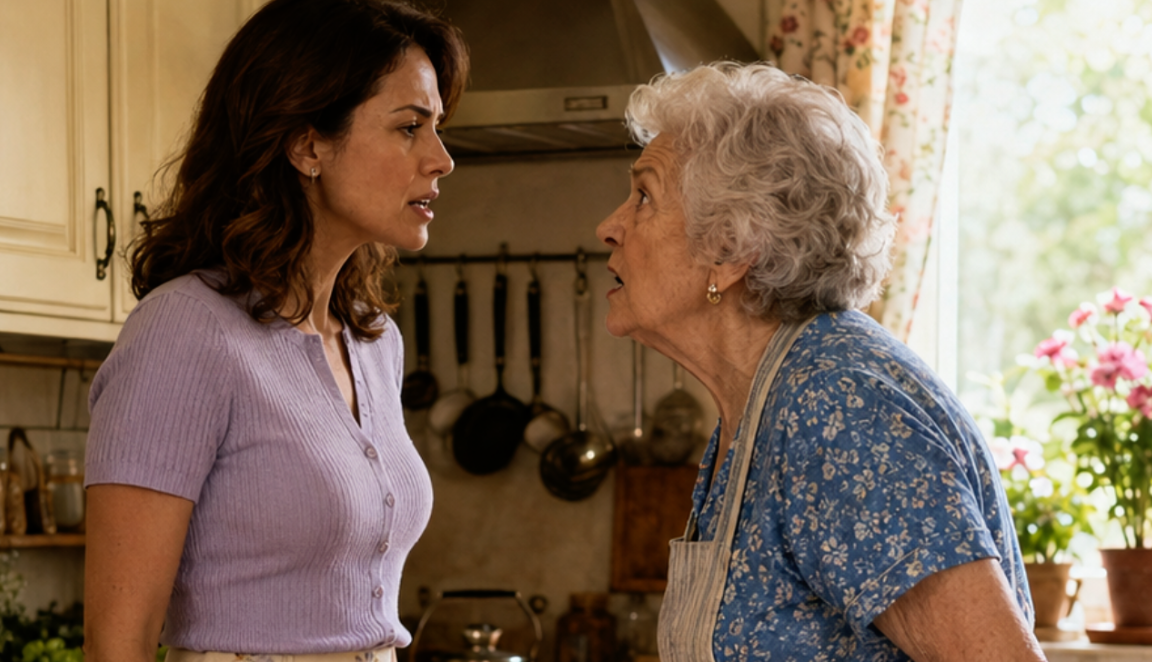
— If you don’t give me back my bank cards, Vera Mikhailovna, I’m not going to keep asking you nicely. I’ll simply have you arrested for theft.
— Vera Mikhailovna, where is my wallet?
Marina’s voice sounded unnaturally calm in the quiet kitchen, as though she were asking what time it was. Her mother-in-law, standing at the stove, did not even turn around. Slowly and methodically, she stirred something thick and crimson in a pot, filling the entire apartment with the rich aroma of borscht. Her movements were unhurried and full of self-importance, as though she were not simply cooking soup but performing some sacred ritual that could not be interrupted over trifles.
— What wallet, sweetheart? — she finally replied without looking away from what she was doing. Her voice was warm and syrupy, like that of a kindly grandmother from a fairy tale. — Did you lose something? Look more carefully. You’re always leaving your things lying around.
Marina remained standing in the doorway with her arms crossed over her chest. She had just returned from the gym, and beneath the thin fabric of her athletic top she could still feel the warmth of her recent workout. That heat contrasted sharply with the icy calm she was forcing herself to maintain.
— I don’t leave my things lying around. The wallet was in the inside pocket of my work jacket in the closet. I left an hour and a half ago, and you were here. I locked the door when I left. No one else was in the apartment except you. So I’m asking you again: where is my wallet?
Vera Mikhailovna finally stopped stirring the soup. She lowered the flame, placed the ladle on a small saucer, and only then slowly turned around. Her face displayed mild bewilderment. She wiped her perfectly clean hands on her apron and looked at her daughter-in-law as though Marina were not a grown woman but a spoiled child who had shoved her own toy under the sofa and was now blaming everyone else for it.
— Marinochka, what are you saying? Are you accusing me of something? I came here to help you while Oleg is away, to keep the house in order and cook meals. And this is how you attack me. Maybe you left it at the gym? Or in the car? You’ve become so absent-minded lately, always running around taking care of your own things.
Every word she spoke was saturated with condescending “concern.” She was not defending herself; she was attacking, trying to make Marina look like an ungrateful, disorganized hysteric. But Marina was prepared for it. She knew every one of her mother-in-law’s tactics by heart. — I paid with my phone at the gym. The wallet isn’t in the car; that was the first place I checked. I’m not absent-minded, Vera Mikhailovna. I remember perfectly well where I put my things. It was a burgundy leather wallet. There were about fifteen thousand in cash inside, along with all my bank cards. You took it.
The accusation came out plainly, without hesitation or softened wording. It hung in the air between them, dense and heavy like the smell of the borscht cooking on the stove. Vera Mikhailovna’s face lost its kindly expression. Her features sharpened, and a cold, calculating gleam appeared in her eyes. She stepped forward, moving out from beneath the shadow of the kitchen cabinets and into the light.
— Are you feeling all right, girl? Oleg left me money. He always takes care of me. Why would I need your pennies? I have enough of my own for household expenses. Maybe you should consider whether there’s something wrong with your head now that there’s no man around to keep an eye on you. Some women lose their minds without that.
That final sentence was a blow to the stomach. A brazen, undisguised slap in the face. Vera Mikhailovna turned back toward the stove, demonstrating that, as far as she was concerned, the conversation was over. She believed she had put her daughter-in-law in her place, humiliated her, and made her question her own sanity.
But she was wrong.
All she had done was ignite a cold, white rage inside Marina, one that now demanded release. Marina realized that polite requests and logical arguments were useless here. It was time for entirely different arguments.
Marina did not move. She merely allowed herself a short, dry laugh devoid of amusement. The sound, sharp and strangely out of place amid the cozy smells of the kitchen, made Vera Mikhailovna tense again.
Marina took several steps forward, entered the kitchen, and leaned her hip against the countertop opposite her mother-in-law. Now only a couple of meters of empty space separated them, and that space instantly filled with hostility.
— Stop putting on this performance, — Marina said in the same even voice, though metallic notes had now appeared in it. — You are not some caring grandmother from a fairy tale, and I am not a naïve idiot. You know perfectly well what I’m talking about. You think you have the right to decide what happens to other people’s belongings.
Vera Mikhailovna pursed her lips. The mask of kindness disappeared from her face completely. She looked at Marina with open, undisguised contempt, as if the woman standing before her were not her son’s wife but some irritating street vendor she wanted to get rid of as quickly as possible.
— Fine, — she hissed, all the sweetness now gone from her voice. — Since you’re so clever, I’ll tell you directly. Yes, I took your wallet. So what?
She demonstratively crossed her arms over her broad chest and raised her chin.
It was not an admission of guilt.
It was a challenge.
— I didn’t steal it. I put it away. Somewhere safe. Safe from you. Because while Oleg is away, I’m the one who should be watching the household and the finances. You waste your money on all sorts of nonsense. Your fitness clubs, endless clothes. But the house needs groceries. Order. So my son comes home to a warm, comfortable house instead of the emptiness you create here.
Marina stared at her, and everything inside her went cold with the crystal-clear realization of what was happening.
This was not merely theft.
It was an ideology.
Vera Mikhailovna genuinely believed she had the right to control, manage, and decide. In her worldview, Marina was not an independent person at all. She was merely an accessory attached to her son.
— My money? — Marina repeated, emphasizing the first word. — Those are my personal cards, Vera Mikhailovna. My salary is deposited into those accounts. Money that I earn myself. What does any of that have to do with your ideas about managing the household?
Her mother-in-law snorted as though she had just heard the most ridiculous statement of her life.
— Your salary! Don’t make me laugh. Everything in this house is Oleg’s money, including your salary. Because you’re his wife. And while he’s away, I’m in charge here. I decide how the family budget is spent. You’d blow everything in a week and then sit around waiting for your husband to come home and fill your wallet again. I’m simply putting things in order. And one day you’ll thank me for it.
It was monstrous.
Her logic was an impenetrable wall built from backward ideas about family and complete contempt for Marina as a person.
Marina understood that arguing, appealing to her conscience, or trying to reason with her was pointless. The woman standing before her would never admit Marina was right, because doing so would destroy her entire worldview.
Which meant Marina needed to speak the only language this woman understood.
The language of power and consequences.
— I see, — Marina said, nodding slowly as though she agreed. Her expression became hard, almost like that of an investigator. — So you have no intention of returning anything.
— I’ll return it when I decide the time is right, — her mother-in-law snapped, already feeling victorious. — When I see that you’ve finally grown up.
Marina straightened, pushing herself away from the countertop. She looked Vera Mikhailovna directly in the eyes, coldly and unwaveringly, without the slightest trace of doubt.
— If you don’t give me back my bank cards, Vera Mikhailovna, I’m not going to keep asking you peacefully. I’ll simply have you arrested for theft!
For a second, fear flashed through Vera Mikhailovna’s eyes.
Not fear of prison—she did not believe for a moment that her daughter-in-law would actually carry out such a threat—but the instinctive fear of a predator backed into a corner that suddenly discovers its intended prey has teeth as well.
But it lasted only an instant.
Her face immediately twisted into an expression of rage mixed with mocking amusement. She let out a short, barking laugh.
— You? You’re going to have me arrested? — she repeated, savoring every word. — You, a nobody, are going to threaten me, your husband’s mother? Because I’m trying to protect his own home from your wastefulness? Have you lost your mind? When Oleg gets back, I’ll tell him everything about how you behave while he’s away. How you slander me—his mother. We’ll see who he chooses.
She turned away, signaling that, in her mind, she had won this round.
Her confidence was absolute.
In her worldview, her son would always take her side, while the daughter-in-law was merely temporary, an easily replaceable element.
Marina’s threat was nothing more than further proof of her supposed instability, another trump card Vera Mikhailovna intended to present to her son.
She removed the pot of borscht from the stove, deliberately making the lid clang loudly, and placed it on a trivet.
She had won.
At least, that was what she thought.
Marina silently turned around and left the kitchen.
She did not continue arguing.
There was no point arguing with a fanatic.
She walked into the bedroom and firmly shut the door behind her.
The following day became a slow, silent torture. The apartment that had once been the cozy little home Marina shared with Oleg had turned into a battlefield. The air felt so electrically charged that it seemed as though a single spark could set everything ablaze.
They did not speak.
Vera Mikhailovna demonstratively took charge of the household, moving from room to room with the expression of wounded virtue. She sighed loudly and spoke on the phone with one of her sisters, intentionally raising her voice whenever she said things like:
“She’s completely out of control.”
“No respect whatsoever.”
“Olezhik will come home and sort this out.”
Marina worked from home, locking herself in the bedroom. Methodically, she answered emails, prepared reports, and participated in online meetings. Her fingers struck the keyboard with the mechanical precision of a robot.
Work—this routine—was her lifeline in an ocean of silent hatred.
She did not enter the kitchen while her mother-in-law was there. She survived on apples and yogurt that she had wisely kept in the bedroom.
She waited.
Waited for Oleg to return.
The confrontation came that evening.
Earlier than expected.
Oleg was not supposed to return until the following afternoon.
The sound of a key turning in the lock shattered the oppressive silence like a gunshot.
Marina froze with her laptop resting on her knees.
From the hallway came Oleg’s tired voice:
— Mom, Marish, I’m home!
Vera Mikhailovna reacted instantly.
As though she had been waiting for that exact moment.
Marina heard her hurried, shuffling footsteps, followed by dramatic lamentations filled with theatrical suffering and false concern.
— Olezhik, my son, you’re back! Thank God, just in time! I’ve been completely beside myself here all alone. I can’t take it anymore.
Marina slowly closed her laptop and stood up.
She was in no hurry.
She gave her mother-in-law every opportunity to fully stage her one-woman performance.
Marina stepped out of the bedroom and stopped in the hallway.
Oleg, exhausted from the journey, stood in the middle of the entryway with a bag in one hand. His mother was clutching his sleeve, her face displaying a masterfully performed expression of grief.
— What happened, Mom? — Oleg asked, shifting his confused gaze from his mother to his approaching wife. — You look terrible… Marina, what’s going on?
— What’s going on, son, is that your wife has completely lost her conscience, — Vera Mikhailovna began rapidly, not giving Marina a chance to say a word. — She accused me of stealing! Can you imagine? Me, your own mother! I came here to help, and she calls me a thief! She can’t find her own things, so she blames me for everything. She even threatened to report me to the police! I never expected this from her, Olezhik. She’s become a complete stranger.
She said all of this while looking not at Marina but at her son, pouring as much self-pity and condemnation of her daughter-in-law as possible into every word.
Oleg looked completely bewildered.
He looked at his wife, and there was no support in his eyes. Instead, there was a silent question mixed with reproach:
How could you?
He expected her to defend herself.
He wanted her to apologize immediately and bring an end to this absurdity.
But Marina remained silent, studying her husband with a cold expression.
She could already see him beginning to lean toward his mother’s side.
And she understood that the real battle was still ahead.
— Oleg, your mother stole my wallet, — Marina said, looking not at Vera Mikhailovna but directly into her husband’s eyes. Her voice was perfectly calm, devoid of emotion, and that calmness made it almost frightening. — She admitted it herself. She doesn’t consider it theft. She calls it “putting the family budget in order.”
Oleg blinked. His exhausted face showed complete confusion.
He looked at his mother, who immediately assumed the role of the suffering martyr.
— Son, she’s twisting everything! — Vera Mikhailovna wailed. — I only wanted to make sure the money was safe! So that when you came home, the refrigerator would be full! I’m doing everything for you, for your family! And she… she sees me as an enemy!
Oleg looked back at Marina.
There was pleading in his eyes.
He did not want this conflict.
He wanted a hot dinner, a shower, and silence.
He wanted the two most important women in his life simply to stop fighting.
— Marish, why are you saying things like that… “Stole”… This is Mom. Maybe you two just misunderstood each other? Mom, just give her the wallet if she wants it so badly. And let’s put an end to this.
It was exactly what Marina had feared.
Not an accusation.
Not shouting.
But this cowardly, conciliatory “let’s put an end to this.”
He was not trying to understand what had happened.
He was trying to bury the problem, offering the easiest solution—and, as usual, Marina was expected to be the one who gave in.
She was supposed to accept that his mother could take her belongings without permission and then condescendingly return them afterward.
— Put an end to what, Oleg? — she asked just as quietly. — To the fact that your mother considers me an incompetent little girl incapable of handling my own money? To the fact that she searches through my personal belongings without permission? Or to the fact that you’re now asking me to pretend none of this happened?
— That’s not what happened! — Vera Mikhailovna exploded, sensing her son’s hesitation. — I wasn’t searching through anything! Your jacket was lying around, and I wanted to put it in the wash. The wallet was inside it! So I put it away somewhere safe!
Oleg seized on this version of events like a drowning man grabbing hold of a lifeline.
— See, Marina! She was just trying to help. Mom, you too… you shouldn’t have done that. Just give it back to her, please, and that’s it. We’re one family. Are we really going to fight over some wallet?
He looked at both women hopefully, pathetic and lost in the middle of their confrontation.
He genuinely did not understand that this had stopped being about a wallet long ago.
It was about power.
Respect.
Personal boundaries.
And right now, at this very moment, he was handing the victory to his mother with his own hands.
Marina looked at her husband, and there was no longer any coldness in her eyes.
There was emptiness.
She saw him clearly now: a weak, immature little boy who would keep hiding behind his mother’s skirt even when his hair turned gray, because it was easier that way.
Standing up to his mother was difficult.
Making his wife “understand and forgive” was easy.
— Vera Mikhailovna, — Marina addressed her mother-in-law again, completely ignoring Oleg. — The wallet. On the table. Now.
Something in her voice made Vera Mikhailovna obey.
She understood that the woman standing before her was no longer joking or merely threatening.
This was a verdict.
Curling her lips in disgust, Vera Mikhailovna left the hallway and returned a minute later, throwing the burgundy wallet onto the shoe cabinet.
It landed with a dull, heavy thud.
— Choke on it, — she hissed.
Marina walked over, picked up the wallet without even checking its contents, and turned toward her husband.
— See, Oleg? It’s very simple. No problems at all, — she said with a faint, almost cheerful smile.
Then the smile disappeared.
— Except you and I don’t have a family anymore. You can stay here with your mother. She’ll do an excellent job putting your finances—and your life—in order.
She turned around and walked into the bedroom to pack her things.
Without saying another word.
— Marina, what are you doing? Where are you going? Wait! — Oleg shouted after her, finally realizing the scale of the disaster.
But she was no longer listening.
He remained standing in the hallway between his mother, whose face was glowing with malicious triumph, and the firmly closed door behind which his wife had just delivered the final verdict on their marriage.
He had tried to reconcile everyone.
And in the end, he was left with nothing—a pathetic referee standing in the ruins of the world he himself had destroyed.