The cutlets had burned on one side. Anna noticed it only when she was already transferring them onto a plate—the crust underneath had turned darker than it should have. It wasn’t a disaster; they were still edible, but she really had poured too much oil into the pan. The frying pan hissed and splattered, and now the stove was covered in greasy spots that Anna was already mentally planning to scrub off after dinner.
Lyudmila Ivanovna sat at the head of the table—always at the head; that had been the rule from the very first day—and sliced bread. Dmitry was scrolling through something on his phone while Anna set out the plates.
“Everything’s ready,” Anna said and sat down.
They ate in silence. It was the usual kind of silence—not hostile, merely familiar. During the eight months she had lived in this apartment, Anna had learned to distinguish between the different kinds of silence at this table. This one was neutral.
Lyudmila Ivanovna took a cutlet, cut into it, and chewed.
“A little too greasy,” her mother-in-law remarked without looking at Anna.
“Yes,” Anna agreed. “I poured in too much oil. I’ll use less next time, and we’ll save a little money too.”
She said it calmly. She had simply voiced what had crossed her mind.
Lyudmila Ivanovna looked up.
“What do you mean, ‘we’ll save’?”
“Well, oil gets used up quickly if you pour it without measuring. It was just an observation.”
“So you think I don’t cook properly?”
Anna opened her mouth and then closed it again. She hadn’t been talking about Lyudmila Ivanovna at all. She had been talking about herself, about the cutlets she had cooked today. But explaining that was pointless. Anna already knew that.
“I was talking about myself,” Anna said anyway.
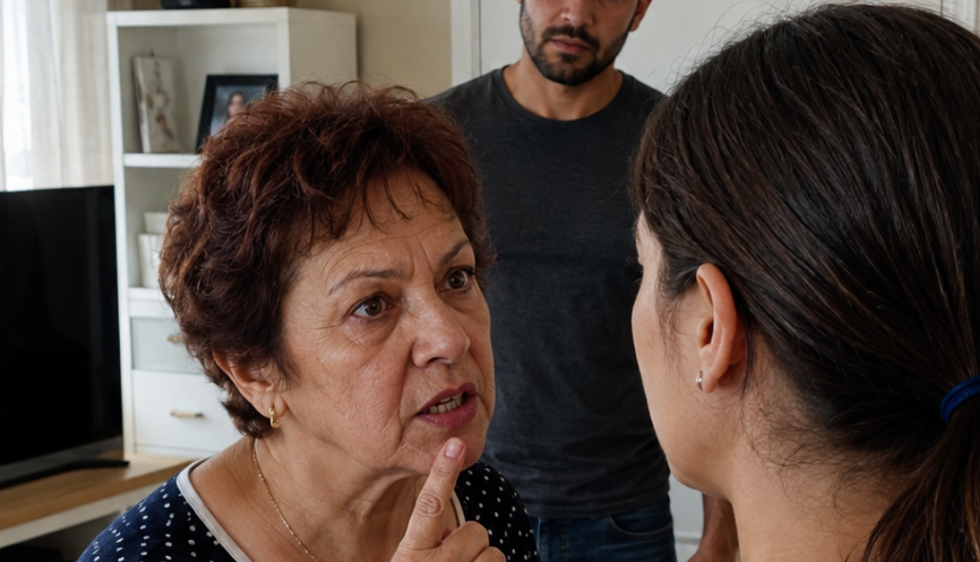
“You’re not even someone in this family who has the right to make comments,” Lyudmila Ivanovna said, putting down her fork. “You live here, you eat here, and you still lecture people about how things ought to be done.”
Dmitry looked up from his phone for a second and then lowered his eyes again.
“I wasn’t lecturing anyone,” Anna said. “I was just…”
“Exactly. Just.” Lyudmila Ivanovna picked up a piece of bread. “Just keep quiet.”
Anna looked down at her plate. The cutlet lay there, sliced in half. She had lost her appetite.
It was the eighth month.
Eight months—and it felt like eight years.
They had moved in with Lyudmila Ivanovna in September after Dmitry lost his job. It happened unexpectedly: his company shut down an entire department and laid off around twenty people at once. Dmitry was among them. At first, it seemed temporary. He would send out résumés and find something else within a month or two.
But one month passed, then another, then a third.
There were interviews, but no offers—or there were offers, but they weren’t what he wanted.
Their rented apartment was eating up their money. Anna worked as a manager at a logistics company and earned fifty-four thousand. By the standards of their city, that wasn’t bad, but it wasn’t enough to cover rent, utilities, and groceries for two people. Dmitry received a small unemployment allowance that barely covered anything.
Lyudmila Ivanovna herself suggested that they move in.
One evening she called and said briefly:
“My second room is empty. Move in. Why waste money on rent?”
Dmitry was delighted. Anna saw how relieved he was, how his shoulders immediately relaxed.
Anna wasn’t delighted, but she kept quiet.
It seemed as though it would only be temporary.
Lyudmila Ivanovna welcomed them neutrally. She showed them the room, explained where everything was kept, and said that she always made her own breakfast and was used to getting up early.
Within the first week, it became clear that her neutrality had merely been a period of observation.
The comments began gradually.
At first they were small and almost harmless: Anna hung the laundry incorrectly, the things in the bathroom weren’t where they should be, she closed the bedroom door too loudly.
Then the remarks became more frequent and familiar, like background noise that you eventually stop consciously listening to but still hear all the time.
“You cook borscht for too long. The beets get overcooked.”
“Anna, after cleaning the floor, you’re supposed to wring the rag out, not just throw it down.”
“What kind of habit is that—going to work without breakfast? That isn’t right.”
Dmitry reacted to all these remarks in exactly the same way. He shrugged and told Anna:
“Don’t pay attention. Mom’s just like that. She doesn’t mean any harm.”
Anna ignored it.
Then she ignored it again.
And again.
Around the third month, Anna calculated how much she was contributing.
Thirty-five thousand went toward utilities and groceries. Lyudmila Ivanovna had said that since they were living there, they should contribute. That was only fair.
Anna agreed.
Thirty-five thousand out of fifty-four.
That left nineteen thousand for transportation, clothes, and everything else. Dmitry spent his unemployment allowance on himself and occasionally contributed a little toward groceries if Anna asked him.
Lyudmila Ivanovna never once said thank you.
Not because she forgot—Anna understood that.
She simply didn’t think it was necessary.
One day in November, Anna made bean soup. Lyudmila Ivanovna tasted it, grimaced, and said the beans should have been soaked overnight instead of coming from a can.
Dmitry was sitting beside them and said nothing.
“They’re canned beans. They don’t need soaking,” Anna said.
“I’ve been making bean soup for thirty years. I know how it’s done.”
“Fine,” Anna said. “Next time I’ll soak them.”
“Exactly.”
That evening Anna told Dmitry that she was tired.
Not tired from work.
Tired of this.
Dmitry replied that she just needed to be patient for a little longer. Soon he would find a job, and they would move out.
Anna nodded.
In December, Dmitry found some temporary work—a two-month project. There was money again, but no conversation about moving out.
Anna waited.
The project ended in January.
Everything went back to the way it had been.
By February, Anna stopped waiting.
Not in the sense that she had made some specific decision. Something inside her simply stopped hoping.
She continued cooking, cleaning, paying thirty-five thousand every month, and listening to remarks.
But somehow she did all of it separately from herself, as though she were watching an unfamiliar woman from the outside—a woman who washed dishes in someone else’s kitchen every evening.
Whether Dmitry noticed the change or not was impossible to tell.
If he did, he said nothing.
He lived as usual. He searched for work without much urgency, watched TV series in the evenings, and sometimes spent weekends at a friend’s place.
He spoke warmly and at length with his mother about various things that had nothing to do with Anna.
By spring, Lyudmila Ivanovna seemed to soften slightly—in the sense that her remarks became less frequent.
At first, Anna thought it might be a sign that something was changing.
Then she realized that her mother-in-law had simply adopted a different tactic: silent disapproval expressed through a look, a pause before answering, or the particular way she pronounced Anna’s name—drawing it out just a little longer than necessary.
Anna learned to notice all of it.
And then she learned not to react.
She simply registered it and moved on.
March was cold. Anna came home late from work because it was the end of the quarter, with reports and meetings piling up.
She got home at eight, sometimes nine.
By then, dinner had already been eaten. Lyudmila Ivanovna and Dmitry ate earlier. Anna reheated whatever was left or cooked something separately for herself.
One evening in early April, she arrived home at around half past eight. There was a pot of soup on the stove—cold, but there was enough left.
Anna ate, washed the dishes, and only then noticed that nobody had wiped down the stove after lunch.
Grease splashes had dried onto it over the past several hours.
Anna took a cloth and wiped them away.
Without saying a word.
That was the evening she realized something had to change.
She still didn’t know exactly what.
She simply understood that she couldn’t keep living like this: silently cleaning someone else’s stove, silently handing over thirty-five thousand every month, silently listening to criticism.
She fried the cutlets on Friday.
She had wanted to make something decent after the workweek—cutlets with potatoes, something simple and filling.
She really had used too much oil.
The pan splattered, so Anna lowered the heat, covered it with a lid, and waited until the cutlets were done.
At the dinner table, Lyudmila Ivanovna chewed silently for the first few minutes.
Then she commented on how greasy they were.
Anna answered with exactly what she had been thinking: that there was too much oil, that she would use less next time, and that they would save some money.
An ordinary sentence.
Nothing special.
“In this family, you’re not even the person who should be discussing how things should or shouldn’t be done,” Lyudmila Ivanovna said in the tone of someone stating an obvious fact. “You sit here, you live here, and then you make comments.”
“I wasn’t making comments,” Anna replied.
“You were. About the oil. About saving money. Who are you to lecture me about saving?”
Anna looked at her mother-in-law.
Then she looked at Dmitry.
Dmitry was studying his plate.
“If I’m nobody,” Anna said evenly, “then this nobody is no longer going to pay for this apartment or the groceries. Let your son support his mother.”
She stood up, picked up her plate, carried it into the kitchen, and placed it in the sink.
Then she went into their bedroom and closed the door.
Lyudmila Ivanovna didn’t let her enjoy the silence for long.
The door flew open—not exactly with a bang, but decisively enough for the handle to hit the wall.
Her mother-in-law walked in and stopped in the middle of the room.
Dmitry hovered behind her, standing in the doorway without entering.
“How dare you?” Lyudmila Ivanovna began, her voice high and tense like a stretched string. “I took you in, I feed you, I put up with your behavior, and you throw money in my face?”
Anna sat on the edge of the bed and looked at her mother-in-law.
She didn’t answer.
“Do you hear what I’m saying?”
“I hear you,” Anna replied.
“Then answer me!” Lyudmila Ivanovna raised her voice. “You think you can just say something like that and walk away?”
“Anna,” Dmitry said from the doorway, “shut your mouth and stop making things worse.”
Anna slowly turned her head toward her husband.
“What?”
“I said, shut your mouth. Mom is upset. You said things you shouldn’t have. Apologize, and we’ll put an end to this.”
There was something about those words—or perhaps the way he said them, casually and matter-of-factly, as though his demand were perfectly obvious—that accomplished what eight months of remarks and silence had failed to do.
Anna stood up from the bed.
“Don’t you dare speak to me like that.”
Dmitry looked surprised.
Genuinely surprised.
In all that time, Anna had never once raised her voice.
Not once.
“What?” he asked.
“You told me to shut my mouth.” Anna spoke loudly, and her voice didn’t tremble, which was strange because everything inside her was shaking. “Don’t you dare. Ever again.”
“You’re my wife. I’ll speak to you however I think is appropriate,” Dmitry said, stepping into the room, his voice becoming harder. “You caused a scene at dinner, insulted my mother, and now you’re trying to tell me how I can talk to you?”
“I’m not going to be your wife anymore.”
The room went silent.
Lyudmila Ivanovna froze.
Dmitry stared at Anna like a man who hadn’t understood a joke.
Anna looked at her left hand.
The ring was simple and smooth. They had chosen it together four years earlier.
She removed it—not abruptly, but calmly—and held it out to Dmitry.
She placed it in his open palm.
“Here,” Anna said. “Take it.”
Dmitry stared at the ring in his hand.
Then he looked up.
“Have you lost your mind?”
“No. I’m just tired.”
“Anna, do you understand what you’re saying?”
“I do. For eight months I cooked, cleaned, and paid thirty-five thousand every month. I listened to remarks about soup, laundry, and the way I close the door. I waited for something to change. Nothing changed. Today I said one sentence about cooking oil, and I was told I was nobody. And you told me to shut my mouth.”
“Mom was upset…”
“Mom is always upset whenever I open my mouth,” Anna interrupted. “That isn’t news. What matters is that every single time, you take her side. Every. Single. Time.”
“She’s my mother!”
“And I’m your wife. Or I was.”
Lyudmila Ivanovna suddenly started talking again—about ingratitude, about what an awful daughter-in-law Anna was, about how her son would find himself a normal woman.
Anna stopped listening.
She opened the wardrobe and took out a travel bag—the one she used on business trips—and began packing.
Methodically, without rushing.
Several changes of clothes.
Her documents from the top drawer.
Her charger.
Her makeup bag.
Dmitry stood in the middle of the room with the ring clenched in his fist.
“Anna, wait. Let’s talk about this properly.”
“We just did talk properly,” Anna said without stopping. “You told me to shut my mouth.”
“I lost my temper.”
“No, you didn’t. You said what you actually think.”
She zipped the bag closed.
Anna put on her jacket and picked up her keys. She still had the keys from their old rental, even though the apartment had been rented out to someone else three months earlier.
Her friend Katya had been telling her for a long time:
“If anything happens, my couch is free.”
At the front door, Anna turned around.
Lyudmila Ivanovna stood against the wall in silence. Apparently what was happening had finally begun to look more serious than an ordinary family argument.
Dmitry looked at his wife.
“Anna,” he said quietly, “don’t do anything stupid.”
“I’ve spent eight months not doing anything stupid,” Anna replied. “Enough.”
She left.
She closed the door behind her without slamming it.
Anna spent three days at Katya’s place.
She didn’t switch off her phone, but she didn’t answer Dmitry’s calls.
Several messages arrived—at first short and angry, then longer.
One said she was being overly dramatic.
Another said that his mother was extremely upset.
There wasn’t a single word about Dmitry himself being upset.
Lyudmila Ivanovna sent her one message too.
It was long.
Anna read halfway through and put her phone away.
The following week, Anna filed for divorce.
There was nothing to divide. They had no jointly owned property, no children, and the apartment didn’t belong to either of them.
The procedure was straightforward.
Dmitry reacted exactly as Anna had expected.
At first, he didn’t believe she was serious.
He called and told her she was going too far, that there was no reason to take things to court because of one argument.
Anna replied that it wasn’t because of one argument.
Dmitry said she was exaggerating everything.
Anna said goodbye and hung up.
Then he came to Katya’s building.
He stood outside the entrance and rang the intercom.
Katya went downstairs herself and told him that Anna didn’t want to talk to him.
Dmitry left.
Another week passed before he called again.
This time, there was no anger in his voice and no attempt to convince her.
There was something different.
Confusion, perhaps.
“Anna, are you serious? Completely serious?”
“Completely,” Anna said.
“Because of the cutlets?”
Anna was silent for a second.
“No, Dima. Not because of the cutlets.”
She didn’t explain any further.
She was tired of explaining.
She said goodbye and ended the call.
Dmitry showed up at the divorce hearing with a lawyer, even though there was nothing to divide.
The lawyer sat beside him looking as though even he didn’t quite understand why he had been hired.
At one point, Dmitry said that Anna had destroyed their family because of her personality and her inability to compromise.
Anna looked at him calmly and told the judge that she could list exactly how much money she had contributed over those eight months, how many remarks she had endured, and how many times her husband had taken her side during disagreements with his mother.
The judge stopped her.
None of that was relevant to the legal case.
The decision was made quickly.
After the hearing, Dmitry caught up with Anna outside.
“Do you understand that you have nowhere to go?” he asked.
He didn’t sound angry.
He sounded genuinely confused.
“You don’t have an apartment. You’re living with a friend.”
“I have a job,” Anna said. “And I have a salary that I can spend on myself now.”
Dmitry opened his mouth and then closed it.
He turned around and walked away.
Anna took a second job.
On weekends, she did bookkeeping for a small company after some acquaintances recommended her.
The pay wasn’t much, but it was steady.
By June, she had saved enough for the first and last month’s rent and rented a one-room apartment.
It was small, on the fifth floor of an apartment block, with a view of poplar trees.
She chose the bed herself.
She chose the curtains too.
Sometimes she thought about Dmitry.
Not with longing.
She simply wondered how he was doing.
Anna knew through a mutual acquaintance that Lyudmila Ivanovna had convinced her son not to try to get his wife back.
Apparently Dmitry had listened to her.
He still lived with his mother and had eventually found some kind of job.
Anna didn’t know the details.
And she didn’t look for them.
One evening in August, Anna sat in her kitchen drinking tea and thought about how much time had passed since that Friday dinner with the cutlets.
Three months.
It felt like longer.
Lyudmila Ivanovna had said that Anna was nobody in that family.
Maybe she had been right.
But that nobody now chose for herself what she would cook for dinner.
She decided for herself when to go to bed and when to open the window.
She paid rent herself—but now it was for her own home, and only for herself.
The sun was setting behind the poplar trees.
Anna finished her tea, placed the mug in the sink, and went to wash the dishes.
Her own dishes.
In her own sink.
It felt good.
Almost ridiculously simple—and good.