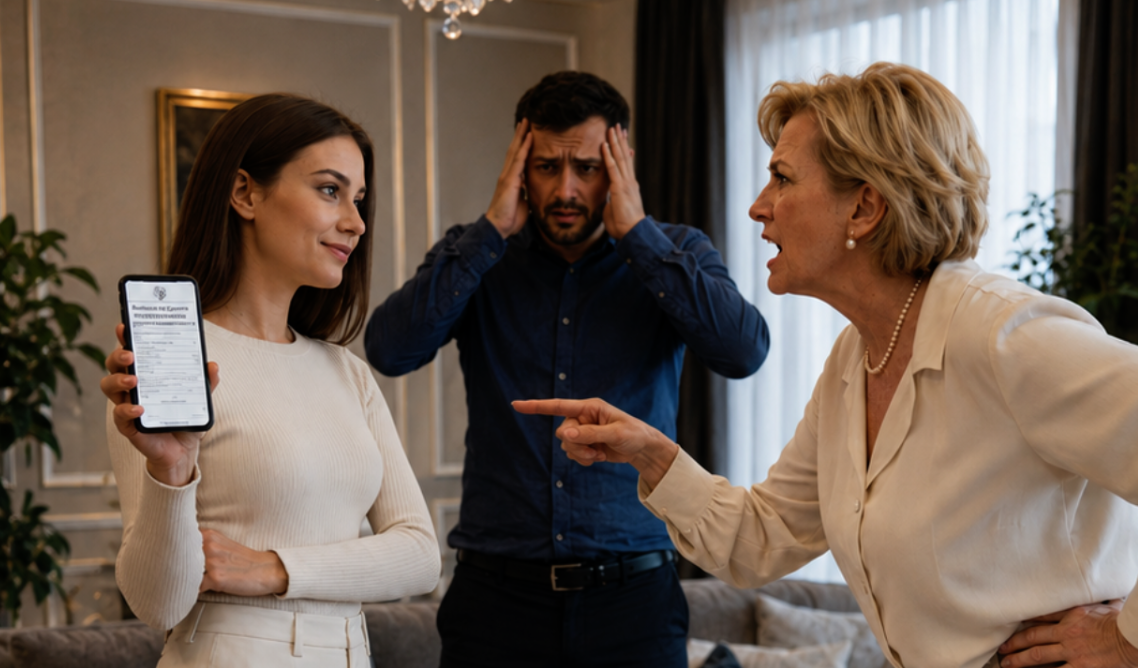
“You’ll get divorced, sell the apartment, and pay me back!” my mother-in-law declared. But I had a surprise prepared.
That day, Irina Borisovna burst in without ringing the doorbell. Alina had only just put her daughter to sleep—tiny Dashenka, who had turned two months old—and was quietly enjoying the thought of finally having a cup of tea while Vitya was at kindergarten. But the silence shattered with the sound of a key turning in the lock. Her mother-in-law still had a set of keys from the time when Denis had insisted that “Mom should be able to help in an emergency.” Alina had regretted a hundred times that she hadn’t changed the locks.
Irina Borisovna, dressed in an elegant pantsuit and smelling of expensive perfume, walked into the kitchen as though she owned the place. She carried a folder in one hand. She didn’t even bother taking off her shoes.
“Well, my dear daughter-in-law, have you enjoyed living in my apartment long enough?” she announced from the doorway.
Alina instinctively pulled Dashenka closer to her.
“Actually, this is our shared apartment. And don’t shout—you’ll wake the baby.”
But Irina Borisovna only snorted, dropped the folder onto the table, snapped it open, and pulled out a sheet of paper—an ordinary handwritten IOU, though it was on stationery bearing the official seal of some government agency.
“Here, take a good look. Denis borrowed two and a half million rubles from me to buy this apartment. The repayment deadline expired yesterday. You’re getting divorced, selling the apartment, and paying me back every last kopeck. Otherwise, I’ll take you to court, and my son will go to prison for fraud. Do you think I’m joking?”
Alina looked at the IOU. Denis’s signature. His handwriting. But everything inside her turned cold not from fear, but from rage. She knew far too well where that piece of paper had come from.
“Careful you don’t choke on it,” she said calmly, stroking her daughter’s back. “I’ve prepared a surprise.”
Her mother-in-law gave a strained laugh and turned toward the doorway, where Denis had appeared behind her, pale and disheveled.
“Denis, tell your wife the jokes are over. Apparently, she doesn’t understand how serious this is.”
Her husband shifted awkwardly beside the doorframe, staring at the floor.
“Alin, Mom really is right… the debt has to be repaid. It’s a matter of honor. You know Mom gave us her last savings.”
“Her last savings?” Alina gave a bitter laugh. “So you really are completely under your mother’s thumb. Well done. Except I know exactly what those ‘savings’ are worth. And anyway—who gave either of you the right to decide what happens to my home?”
Irina Borisovna’s face turned crimson. She suddenly stepped toward the table, grabbed the electric kettle, and hurled it against the wall with a crash. The plastic cracked, water splashed across the tiles, and the baby flinched and began to cry. Alina instinctively turned away, shielding her daughter, while with her free hand she found the phone in the pocket of her house dress and started recording video. The camera was pointed directly at the raging woman.
“I’ll teach you some respect for your elders, you bitch!” her mother-in-law screamed. “Get out of here with both your brats! This apartment was bought with my money! You’re nobody here!”
Denis rushed toward his mother.
“Mom, stop it. Don’t…”
But Irina Borisovna was already jabbing a finger at Alina.
“Remember this: you’ll get divorced, sell the apartment, and pay me back. Or I’ll destroy you. I have connections everywhere.”
Alina silently stood up, holding her crying daughter tightly, and as she passed her husband she said quietly:
“You have no idea what I’ve prepared.”
She went into the bedroom, locked the door, and only after she heard the front door slam behind her departing husband and mother-in-law did she finally exhale.
Her hands were shaking, but her mind remained cold and razor-sharp.
She had been waiting for this moment for three years.
And she knew there would be no mercy.
It had all begun when she and Denis were still planning to buy the apartment. Alina had inherited a modest but substantial sum from her grandmother, and they also had maternity capital from Vitya’s birth. Living with their parents had become unbearable, and they desperately wanted a place of their own.
At the time, Irina Borisovna had offered them “a little help”—two and a half million rubles, supposedly because there was no way they could manage the down payment without taking out a mortgage.
Alina agreed, but insisted that the children’s shares be legally allocated immediately and that her personal contribution—the inheritance—be formally recognized as her separate property. Her mother-in-law frowned at the arrangement, but signed the documents.
A year later, Alina accidentally saw an open messenger conversation on her husband’s tablet. Denis had forgotten to log out of his account on the device they kept in the living room.
It was a conversation with his mother.
Alina’s eyes caught one particular sentence:
“Son, the IOU is just a formality, but that girl needs to know her place. If anything happens, we’ll throw her out with nothing.”
Denis had replied:
“Okay, Mom.”
Alina felt ice spread through her body.
She scrolled farther up and found another message:
“The important thing is that she doesn’t know I’m simply giving you the money as a gift. Write the IOU, but you and I both know there’s no debt. Let her think we did her a favor.”
That was when Alina realized she was living in a nest of snakes.
She didn’t start a confrontation.
Instead, she took screenshots, sent them to herself, and then discreetly hired a private notary who helped document the digital copies and officially certify the screenshots with their dates and timestamps.
Several months later, Alina managed to record another conversation.
They were celebrating Irina Borisovna’s birthday at a restaurant. Denis, slightly drunk, was hugging his mother when she became emotional and announced loudly:
“Denis, don’t you dare pay that money back! It was your wedding gift, just like I told you! We only wrote the IOU for tax purposes so nobody would start asking me questions about such a large amount. Relax, son. Everything is fair.”
Alina sat beside them drinking champagne and smiling, while the voice recorder hidden in her jacket pocket continued running.
Every word had been recorded.
Now that her mother-in-law had launched an open attack, Alina knew she had a weapon.
The next three days passed in a haze.
Denis didn’t sleep at home. He went to stay with his mother.
Alina filed a police report concerning the threats and destruction of property.
On Thursday morning, someone rang the doorbell again.
Two people were standing outside.
One was a lean man in a formal suit carrying a briefcase. He introduced himself as Irina Borisovna’s attorney. The other was a heavyset woman carrying a tablet—a real estate agent.
“We’re here to inspect and appraise the apartment,” the lawyer said without any introduction. “My client insists on settling the matter before trial. If you refuse to sell voluntarily, we will petition the court for a forced sale to satisfy the debt. The statute of limitations has not expired.”
Alina blocked the doorway.
“There will be no inspection. This is private property. Get out.”
But at that very moment, Irina Borisovna emerged from farther down the stairwell, with Denis following behind her.
Her mother-in-law looked triumphant.
“You see, Denis? Look how crazy your wife has become,” she said. “All right, ladies and gentlemen, come in. As the mother of one of the owners, I give you permission.”
She shoved Alina aside with her shoulder.
The real estate agent immediately marched across the parquet flooring in her high heels and began measuring the rooms with a laser distance meter.
Holding the now-awake Dashenka against her chest and gripping the hand of frightened Vitya, who had just returned from kindergarten, Alina shouted at her husband:
“Denis, stop this! Do you understand what they’re doing to your children?! This is their home!”
Her husband flinched. For a moment, doubt appeared in his eyes.
But his mother snapped:
“Don’t listen to her! She’s wrapped you around her finger! Debts have to be paid.”
The real estate agent leaned out of the children’s room.
“The market value is around five million. After deducting the debt and legal expenses, you’ll have maybe five hundred thousand left. No more.”
“You see?” Irina Borisovna smirked. “You’d better agree voluntarily.”
Alina couldn’t take it anymore and lunged toward the unwelcome visitors, but Denis intercepted her. He grabbed both her arms and squeezed so hard that red marks appeared around her wrists.
“Let go of me,” she hissed. “I’m calling the police.”
“Don’t be stupid,” he growled. “Mom knows what she’s talking about.”
Vitya burst into tears and ran toward his mother, but tripped over the threshold and fell.
The moment Alina saw her crying son, she jerked free with such force that Denis, caught by surprise, released her.
She dropped to her knees and pulled both children close.
Her mother-in-law grimaced.
“Oh, wonderful. Now she’s hysterical. That’s enough for today. Denis, let’s go home. You need some rest.”
They left behind the lingering smell of expensive perfume and a feeling of filth.
Alina stood up, calmed the children, and after making sure they were safe with a neighbor, went to the emergency clinic.
The bruises on her arms and the injury to her knee were officially documented, and she was given a medical certificate.
That same evening, she filed a police complaint against her husband for assault and against her mother-in-law for taking matters into her own hands and making threats.
She also sent copies to child protective services, explaining that physical confrontations and violent arguments had taken place in front of her young children.
That night, sitting in the kitchen beneath the dim glow of a night-light, she called her attorney.
Anton Pavlovich, a former judge with twenty years of experience, listened calmly, asked several questions, and told her to bring him every recording and bank statement she had.
The next day, Alina went to the bank.
It took several hours to retrieve the archived records.
On the date written on the IOU, Irina Borisovna had indeed withdrawn two and a half million rubles from her bank account.
But what happened afterward was far more interesting.
Two days later, exactly the same amount had been deposited back into her savings account.
The money had never actually been transferred.
The IOU documented a nonexistent loan.
It was a sham.
Alina requested an official bank statement bearing the bank’s seal.
That evening, an unexpected visitor came to see her—a thin woman of around thirty-five with tired eyes.
It was Ekaterina, Denis’s biological sister. Alina only vaguely knew of her existence because Irina Borisovna had cut her daughter out of her life after Katya refused to give her mother her share of the family apartment.
Katya sat in the kitchen drinking tea and told her story.
“Mom threw me out the same way. After Dad died, she gave me documents to sign, telling me they were for processing the inheritance. In reality, I was signing away my share. I trusted her back then. Now I live in a rented apartment. When I heard what she was doing to you, I realized I had to help. I’ll tell the court everything—how Mom has been pulling schemes like this for years. She’s even convinced my brother that he owes her for the rest of his life.”
Alina hugged Katya.
Now she didn’t just have documentary evidence.
She had a witness.
Two days later, Anton Pavlovich filed a counterclaim asking the court to declare the IOU invalid due to the absence of any actual loan and seeking compensation from Irina Borisovna for the attempted fraud.
A week later, the first hearing in Irina Borisovna’s lawsuit took place.
The courtroom was packed.
Irina Borisovna arrived wearing a wet-asphalt-colored dress, her hair styled perfectly, playing the role of the noble mother betrayed by an ungrateful daughter-in-law.
Denis sat behind her with his head lowered.
His mother gave her testimony with theatrical sighs.
“I gave them my last savings, and now these ungrateful people are going to leave me without a home…”
The judge, an older woman, listened attentively.
When Alina’s turn came, she requested permission to submit physical evidence.
Her attorney handed the judge a folder containing the notarized screenshots of the messages, the bank statement showing that the money had returned to Irina Borisovna’s account, and a disc containing the audio recording.
Her mother-in-law tensed.
“Your Honor,” Alina began calmly, “this money was never transferred to us. The IOU was a sham created so that they could later take possession of our apartment. May we play the recording?”
The judge nodded.
Silence fell across the courtroom.
Then Irina Borisovna’s unmistakable voice came through the speakers:
“Denis, don’t you dare pay the money back! It was your wedding gift, just like I told you! We only wrote the IOU for tax purposes…”
A collective gasp swept through the room.
Denis turned white as a sheet.
His mother jumped to her feet.
“It’s fake! It’s been edited!”
“Silence!” the judge said sharply. “The recording has been admitted into evidence. Continue.”
Anton Pavlovich then requested that Ekaterina be called as a witness.
She confirmed that her mother had repeatedly referred to the money as a gift and had said that “the IOU was insurance against the daughter-in-law.”
Finally, Alina presented the bank records.
The money had been withdrawn and then returned.
The fact that the supposed loan had never actually been funded was established.
The judge retired to deliberate.
When she returned, she announced the decision.
Irina Borisovna’s lawsuit was denied in full.
She was ordered to reimburse the legal expenses.
In addition, the court found indications that the claim may have been knowingly fraudulent and ordered the case materials forwarded to investigators to determine whether a criminal offense involving attempted fraud had occurred.
The courtroom erupted into murmurs.
Irina Borisovna gasped and clutched her chest, but Alina’s attorney added calmly:
“We insist that criminal proceedings be initiated for knowingly making false accusations and attempting to unlawfully seize real estate. Your Honor, I ask that this be entered into the record.”
Her mother-in-law went pale.
Leaning on her son’s arm, she staggered out of the courtroom.
Denis turned around, met Alina’s eyes, and whispered:
“I’m sorry.”
She looked away.
Forgiveness was not part of her plans.
The divorce was finalized a month later.
Alina filed for dissolution of the marriage and division of marital property.
Because the children’s shares had been notarized and because there was proof that neither Denis nor his mother had actually contributed financially, the court determined that Denis’s share in the apartment amounted to only one eighth—a symbolic portion that could not realistically be separated without requiring him to pay an enormous compensation amount.
During the property division hearing, Alina stated:
“I’m prepared to buy his share at a fair price. Everyone knows the market value of a one-room apartment in this neighborhood. I’m offering one hundred and twenty thousand rubles, along with waiving my claim for past-due child support.”
Denis tried to object, but his lawyer explained that this was about the most he could realistically expect.
Sitting in the back row, his mother shouted:
“This is robbery!”
The judge immediately silenced her.
In the courthouse hallway, Denis caught up with Alina.
“Alin, please… I was an idiot. Can we start over? I won’t listen to my mother anymore.”
She looked at him without hatred, but with coldness.
“You nearly took the roof from over your own children’s heads with your own hands. Remember how you grabbed my arms? Remember your mother throwing the kettle? Whose side were you on then? And in that courtroom, you sat there supporting a lie. It’s over.”
She turned and walked away.
Vitya, who was waiting with the neighbor, asked:
“Is Daddy bad?”
“No, sweetheart. Daddy is just weak. But we’re strong. We’ll manage.”
Denis moved in with his mother.
Now the two of them were crammed together in Irina Borisovna’s small two-room Khrushchev-era apartment.
Soon, neighbors began complaining about the constant shouting coming from inside.
His mother took her anger out on her son.
Denis started drinking.
Meanwhile, Alina gradually put her life back in order.
After receiving three hundred thousand rubles in reimbursement for her legal expenses, she paid off the remaining mortgage balance.
She also helped Katya.
The two women had become close, and Alina invited her to stay temporarily in the spare room until she got back on her feet.
The home was finally filled with peace.
Later, her mother-in-law appealed the ruling, but the appeal was rejected.
Alina then sued her for emotional damages caused by the slander and won.
Bailiffs seized Irina Borisovna’s country house.
She eventually sold it for next to nothing in order to settle her debts.
Denis took a second job as a stocker at a supermarket.
One day, Alina sent him a small bill for having some old furniture removed—the same furniture his mother had once insistently forced upon them.
It was petty, perhaps, but it felt like a sobering final period at the end of the story.
A few days later, however, Alina received another court summons addressed to her mother-in-law in connection with a new case.
Without reading it, she tore it up over the trash can.
She had no desire to sink to their level.
A year passed.
Alina returned to work at a large company where she was appreciated, and in the evenings she taught online accounting courses for mothers on maternity leave.
A nanny looked after Dashenka and Vitya, and on weekends they went for walks in the park.
Someone new appeared in her life—a widower named Roman, a pediatric surgeon who was calm and dependable.
They were in no hurry to get married.
Each maintained their own home, but they spent quiet evenings together, and the children called him Uncle Roma.
For the first time in a long while, Alina finally felt safe.
More importantly, she felt that she was once again in control of her own destiny.
One Saturday, they went to the shopping mall to buy Vitya’s school uniform.
The boy ran ahead holding a balloon, while Dasha slept in her stroller.
Near the escalator, Alina suddenly froze.
Denis was walking toward them.
He looked as though he had aged ten years. His face was gaunt, his sweater wrinkled, and he was pushing a shopping cart loaded with cheap pasta and canned food.
Beside him hobbled Irina Borisovna with a walking stick.
She, too, seemed faded and diminished, her face bitter and sour.
They noticed Alina at the same moment.
Denis flinched and took a step toward her.
Alina shook her head and said quietly:
“Don’t, Denis. You made your choice.”
Vitya, who didn’t recognize his father, tugged at her hand.
“Mom, come on! There’s a carousel over there!”
Alina put an arm around her son, adjusted the blanket covering Dasha, and walked toward the escalator without looking back.
Roman took the stroller from her.
“Are you okay?” he asked softly.
“Yes,” she replied. “Now I absolutely am.”
Behind them, her mother-in-law hissed something, but her words disappeared into the noise of the shopping mall.
Alina thought to herself that the surprise had indeed worked.
Only the real surprise had never been about revenge.
It had been about surviving.
About refusing to break.
The war was over.
Life went on.