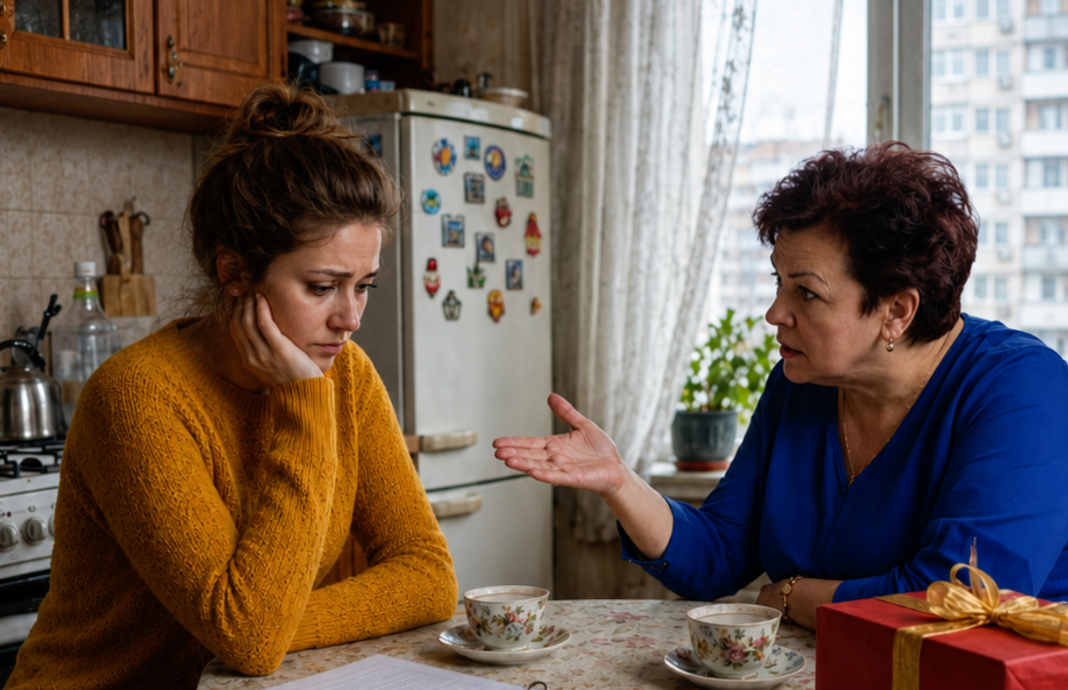
“I heard about the apartment you inherited from your grandmother. Consider my Women’s Day gift already taken care of—give the apartment to me.”
“I heard about the apartment you inherited from your grandmother. Consider my Women’s Day gift already taken care of—give the apartment to me,” her mother-in-law declared categorically, casually stirring sugar in a faceted glass.
The teaspoon tapped rhythmically against the glass. Clink-clink-clink. Suddenly, the sound seemed louder to Nadya than the rumble of the trams passing beneath the window.
Nadya froze with a towel in her hands. They were sitting in the tiny kitchen of the rented two-room apartment on the outskirts of the city. Outside, the wet March slush mixed with dirty snow, while a kettle coated with years of limescale cooled on the table.
“Galina Sergeyevna, are you serious?” Nadya slowly lowered herself onto a stool, feeling everything inside her tighten into a hard, icy knot. “That’s my grandmother’s apartment. A one-room apartment on Pervomayskaya Street. It hasn’t even had a proper renovation since the Olympics. And besides… why am I supposed to give it to you?”
Galina Sergeyevna carefully placed the spoon on the saucer, pursed her lips, and looked at her daughter-in-law with the slight squint of someone explaining basic arithmetic to a foolish child.
“And who do you think needs it more? You and Vadik are young—you’ll earn enough for another place. You both work day and night anyway. But I have back problems, arthritis, and besides, I’m your husband’s mother. I worked my whole life at a garment factory, wore my fingers raw raising Vadik, and I’m still living in my wreck of a house where the roof leaks every summer. The apartment on Pervomayskaya is on the fifth floor, dry and quiet. Besides, March Eighth is coming up. Vadik always gives me some nonsense—a blender one year, a scarf the next. But this would actually be real help for the family.”
Nadya stared at her mother-in-law and, for a second, questioned her own sanity.
Nadya worked as an archivist at a district outpatient clinic. For fifty thousand rubles a month, she spent every day sorting through thick medical files that smelled of old paper, entering information into a glitchy electronic database, and listening to irritated remarks from doctors. Her husband, Vadim, worked as a shift supervisor at a pulp-and-paper mill. His shifts were long and often overnight, with the constant smell of chemicals and dampness, and by the age of thirty he had developed a chronic cough from the working conditions.
They had been saving for a place of their own for four years. They skipped vacations, bought clothes during sales, and counted every ruble. The only bright spot in the endless cycle of gray everyday life had been Grandma Lyuba. The old woman lived quietly, grew geraniums on her windowsill, and until her final days still went out to buy her own bread. When Grandma died a month earlier, Nadya cried for three days straight—not because of the inheritance, but because together with her grandmother, she had lost the only place where she had always been welcomed with warmth and without demands.
And now there were thirty-four square meters in an old Khrushchev-era apartment, with herringbone parquet flooring and an antique sideboard. For Nadya and Vadim, it was their only chance to escape the burden of paying rent.
“Does Vadim know about your… proposal?” Nadya asked quietly, gripping the starched edge of the tablecloth in her fist.
“Vadik is a sensible boy,” Galina Sergeyevna snapped, getting up from the table. “I’ll talk to him myself this evening. He won’t refuse his mother. You’d better start dealing with the paperwork so we can transfer everything before the holiday. Don’t make a scene, Nadya. We’re one family.”
Her mother-in-law left, leaving behind the lingering smell of cheap face powder and an absolute, ringing emptiness.
Vadim returned from his night shift close to five in the evening. His eyes were red with exhaustion, and his jacket reeked of machine oil. He took off his shoes, dropping his heavy boots noisily onto the linoleum in the hallway, and immediately went into the kitchen, where Nadya sat silently in front of a cup of cold tea.
“Nadya, why are you sitting in the dark?” He flicked on the switch. A dim bulb beneath a yellow lampshade illuminated his tired, drawn face.
“Your mother came by,” Nadya said directly. “She said Grandma Lyuba’s apartment is going to be her March Eighth present. And she said you would agree.”
Vadim froze with his cup halfway to his mouth. Slowly, he put it back on the table, rubbed the bridge of his nose, and let out a heavy sigh. Nadya knew that sigh all too well. It was the way he always sighed whenever he wanted to avoid a direct confrontation.
“Nadya… You know what Mom is like. She’s just… emotional.”
“Emotional? Vadim, she literally demanded that I transfer the apartment into her name. The apartment we were planning to move into next month! So we wouldn’t have to keep paying Uncle Gena thirty thousand rubles a month for this dump!”
“Well, look,” Vadim said, sitting on the edge of a chair and trying to take Nadya’s hand, but she pulled away. “Mom’s roof really does leak in her private house. It’s hard for her to carry firewood, and that boiler keeps going out… She isn’t even sixty-five yet, but she’s sick all over. If we give her the one-room apartment, she can sell her house and give us the money for a down payment on a two-bedroom place…”
“Vadim, your brother Kolya has been living in that house for three years without paying a single thing!” Nadya interrupted, her voice cracking into a high pitch. “If your brother and his endless ‘business ideas’ need that house, then let him buy your mother an apartment himself! What does my grandmother have to do with it? What does our life have to do with it?”
“Stop shouting!” Vadim suddenly snapped, and his voice filled with that dull, everyday anger that lurks at the bottom of the soul of anyone catastrophically exhausted. “Kolya is barely making ends meet! He has three children! You and I don’t have anyone! Who are we saving those square meters for? Are you really that stingy when it comes to my mother? She raised me alone after my father ran away!”
The words hung in the air like heavy smoke.
“You and I don’t have anyone.”
Nadya looked at her husband as though she were seeing him for the first time. The man with whom she had once shared a single portion of pasta during the week before payday, the man with whom she had dreamed of covering the walls of their future bedroom with light-colored wallpaper, was now staring at her like a cornered animal she no longer recognized.
“I see,” Nadya said quietly. “So you’ve already decided everything.”
“I haven’t decided anything!” Vadim muttered, turning toward the window. “We just need to handle this like decent people… You can’t immediately dig your heels in like this. The holiday is coming up, and now we have a family scandal.”
“The scandal isn’t in our family, Vadik. Your mother is trying to take the last thing I have left from the person who truly loved me.”
Nadya stood up, took her coat from the hanger, and went outside.
A light rain was falling. In March, the city always looked as though someone had forgotten to wash it after a long, dirty winter. Nadya walked along the broken pavement without paying attention to where she was going. Her boots became soaked almost immediately, but she didn’t feel the cold. One thought kept circling in her head:
“How did we end up like this?”
They had married five years earlier. There had barely been a wedding—they registered their marriage at a modest registry office and then sat in a café with two friends. Back then, Galina Sergeyevna had given them a set of bed linens and said, “Enjoy life while you’re young. We’ll see what happens later.”
Well, now they could see.
Nadya reached Grandma Lyuba’s building.
The old five-story apartment block greeted her with the familiar smell of dampness, sauerkraut, and old wood. Nadya climbed to the fifth floor, pulled a heavy metal key from her bag, and unlocked the peeling brown door.
The apartment was quiet. And it smelled strongly of Grandma—dried mint, Validol, and old books.
Nadya switched on the hallway light. A mirror in a wooden frame hung on the wall, with a crocheted doily beneath it. Nadya went into the main room. In the corner stood a sofa covered with a blanket, and on the table was a wooden jewelry box.
Nadya walked over and opened it.
Inside were old photographs, a couple of her grandmother’s medals for distinguished labor, and a neatly arranged folder containing the apartment documents.
At the very top of the folder lay a note written in Grandma’s small, trembling handwriting:
“My dear Nadya. This is your home. Don’t listen to anyone and don’t be afraid of anything. You’re strong. Be happy.”
Nadya sat down on the sofa, pressed the note against her chest, and burst into tears. For the first time during that horrible day, she sobbed uncontrollably, loudly, gasping like a little girl.
She cried for her grandmother, for her ruined marriage, and for the five years she had spent believing in the illusion that she and Vadim were truly a team.
The next day, Nadya took a day off work.
She called a maintenance locksmith and had the lock on her grandmother’s apartment changed. Then she went to the Multifunctional Public Services Center and submitted the documents to register ownership exclusively in her own name. Fortunately, because the apartment had been inherited, it was not considered jointly acquired marital property.
When she returned to the rented apartment, Vadim wasn’t there—he had gone to another shift.
Nadya pulled two large suitcases from the closet.
She packed her belongings methodically and calmly. Her sweaters, her books, archive folders, the mug with the chipped handle she had bought at her first job.
There was no anger left.
Only a clear, ringing sense of certainty remained.
Her phone rang at seven in the evening.
The screen displayed: Nadya took a deep breath and pressed the green button.
“Well, Nadya?” Galina Sergeyevna’s loud, triumphant voice came through the phone. “Vadik told me everything. You’ve had your cry, and that’s enough. Tomorrow at ten, we’re meeting at the notary’s office. I’ve already arranged everything with our Sofya Mikhailovna. We’ll draw up the deed of gift. You understand that this is the right thing to do. We’ll get you a March Eighth present too—a nice set of enamel pots.”
Nadya remained silent for a couple of seconds, listening to the woman’s confident breathing on the other end of the line.
“Galina Sergeyevna,” Nadya said calmly and distinctly. “Cancel the notary.”
“What?” Her mother-in-law’s voice instantly lost its smugness and became sharp. “What nonsense have you come up with now?”
“I’m not giving the apartment to anyone. Not to you, not to Vadim, and not to your younger son. It’s my home. I’m moving there tomorrow.”
“You… you ungrateful bitch!” Galina Sergeyevna shrieked through the phone. “Vadik will leave you! He won’t even let you through the door! You want to destroy our entire family over some miserable little hole?!”
“Vadim has already left, Galina Sergeyevna. Or rather, I’m leaving him. And as for the holiday… Happy upcoming International Women’s Day. Buy yourself whatever gift you’ve earned.”
Nadya ended the call and immediately blocked her mother-in-law’s number.
On March seventh, wet but unmistakably springlike snow was falling.
Nadya stood in the middle of the room on Pervomayskaya Street. Around her were cardboard boxes, bags filled with belongings, and her grandmother’s old furniture. The air smelled of fresh paint—Nadya had already bought a couple of cans of white enamel and painted over the peeling radiators.
Her phone lay on the table.
Over the previous twenty-four hours, Vadim had called forty times.
He had written two dozen long, confused messages—sometimes begging her to forgive him, sometimes accusing her of selfishness, sometimes claiming that his mother had “taken to her bed with heart trouble,” although Nadya knew perfectly well from a neighbor that Galina Sergeyevna had cheerfully gone to the market that very morning to buy fresh fish.
Nadya didn’t answer a single message.
She walked over to the window.
Below, cars rumbled along the street. A vendor outside the grocery store was unloading boxes of mimosa flowers—yellow, fluffy little balls carrying the sharp, clean scent of spring.
People were walking home from work, carrying transparent bags with cakes inside and hiding long tulip stems beneath their jackets.
Ordinary people.
Accountants, locksmiths, nurses, factory supervisors.
All of them were hurrying somewhere, waiting for something, hoping for something.
Nadya opened the small window.
Fresh, cool air rushed into the room.
She knew that difficult things were waiting for her: a painful conversation with Vadim, a complicated divorce, the delicate division of what little money remained in their savings account, and long months of loneliness in this old apartment.
She would have to fix leaking faucets herself, move wardrobes herself, and learn how to live all over again on nothing but her archivist’s salary.
But for the first time in many years, Nadya felt as though an enormous, crushing stone had been lifted from her chest—a burden she had willingly carried all this time.
She walked over to the sideboard, took out a small glass vase, filled it with water, and placed on the table a sprig of mimosa she had bought for herself on her way home from the Multifunctional Public Services Center.
The tiny yellow blossoms glowed in the dim light of the March evening.
“Happy Women’s Day to me,” Nadya whispered into the empty room.
And for the first time in a very long while, she smiled.
Truly smiled.